Early-maturing variety, obtained at the All-Russian Research Institute of Genetics and Breeding of Fruit Crops named after I.V. Michurin through open pollination of Siberian subspecies black currant seedlings with European varieties. Author: I.A. Tolmachev. Included in the State Register of Varieties Approved for Use in the Central, Volga-Vyatka, Central Chernozem, Middle Volga, Lower Volga, and Ural regions in 1959.
Medium-height, medium-spreading, sparse bush. Growing shoots are thick, straight, light-green. Buds are medium-sized and large, egg-shaped, sit on thick stems, deviated from the shoot or parallel to it. Leaf scar shape is narrow, rounded.
Leaf is five-lobed, medium and large, dark green, leathery, wrinkled. Leaf blade is smooth, shiny, slightly concave, folded along the central vein, leaf margin is wavy. Lobes are pointed, middle lobe is wedge-shaped, well-developed. Basal lobes are moderately or weakly developed. Leaf base is heart-shaped with a medium or deep notch. Teeth are medium-sized and sharp. Petiole is medium-length, covered with long hairs at the leaf base.
Flowers are medium-sized, bell-shaped, calyx lobes are reddish, curved downward, some are twisted. Inflorescence is short (5.5 cm), with hairy medium-length peduncle, dense, hanging. Axis is thin or medium, with "sunburn".
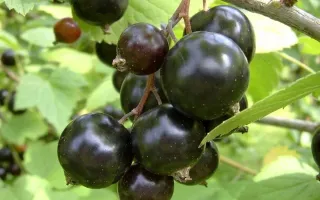
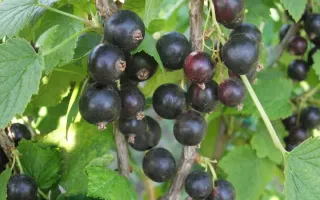
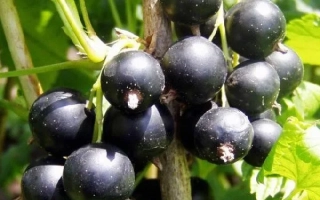
Berries are medium to large (0.7-1.1 g), round, one-dimensional, black, shiny, with thin delicate skin, medium seed content, pleasantly tart-sweet flavor (3.9-4.1 points). Calyx is round, medium-sized, half-open, pedicel is medium-length. Chemical composition: dry solids - 12.9%, total sugars - 8.8%, titratable acidity - 3.4%, ascorbic acid - 179.0 mg/100 g, P-active substances - 456.0 mg/100 g, pectin substances (dry weight) - 0.3%.
Winter-hardy, high-yielding, self-fertile, average yield 10.0 t/ha (2.8 kg/plant).
Advantages of the variety: simultaneous ripening of berries, high productivity.
Disadvantages of the variety: susceptible to powdery mildew and anthracnose, insufficient berry size.







Reviews · 1