


SKU #4515
·
249 views
Currant Call Back (Romance)
Currant
Type of Variety
Blackcurrant
Your mark
0 votes
0% positive ratings
Store offers · 1 from 1 store
1 offer in 1 store — from 2.21 € per seedling.
Available at: Сад Мордовии
Prices are collected automatically from store websites and converted at the current exchange rate. Check the price and availability on the store website before ordering.
Description
Medium-ripening variety, obtained at the Sverdlovsk Selection Station of Horticulture from open pollination of the 'Leningrad Giant' variety. Author: T.V. Shagina. Included in the State Register of Varieties Approved for Use in the Volga-Vyatka Region in 2004.
Weak-growing, medium-spreading, sparse bush. Growing shoots are thick, green, weakly tinted with anthocyanin, hairless. Woody shoots are thick, dark-gray, hairless. Buds are large, solitary, with blunt tips, round, often arranged oppositely, colored, weakly hairy, deviated from the shoots. Apical bud is free. Leaf scar shape is round-triangular.
Leaf is three-lobed, medium-sized, green, matte, wrinkled, folded along main veins. Middle lobe is broadly triangular with a sharp tip, slightly longer than lateral lobes, with additional protrusions. Lateral lobes are short, broad, sharp, tips directed sideways, angle between their veins obtuse. Basal lobes are poorly developed, their veins spread out. Leaf base is heart-shaped, notch narrow, central, open. Teeth are large, with clearly defined 'tip'. Petiole is long, thick, hairless, tinted with anthocyanin, positioned on the shoot at a right angle.
Flowers are large, round, with brightly colored, freely positioned sepals. Inflorescence is short, dense. Pedicel is short, brown-green, hairless.
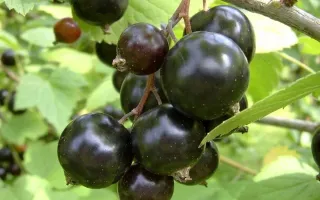
Berries are large, round, black, with dry detachment, with average number of medium-sized seeds, sweet taste, culinary use. Calyx is small, non-detaching, closed. Chemical composition: dry substances - 12.0%, sugar sum - 6.7%, titratable acidity - 2.6%, ascorbic acid - 165.1 mg/100 g.
Highly winter-hardy, self-fertile (up to 70%), high disease resistance, yield 7.0 t/ha.
Advantages of the variety: large-fruited, excellent taste, high resistance to fungal diseases, early ripening, high winter hardiness.
Disadvantages of the variety: damaged by bud mite, shoots may split under heavy fruit load, very dense inflorescence.
Crop & resistance
Crop
Disease resistance
Specifications
| Type of Variety | |
|---|---|
| Catalog | Catalog → Currant |
No reviews yet. Be the first to share your experience.
Alternatives
Currant saplings · similar varieties


See also
Often considered together with this variety




Recently viewed
Products you’ve viewed on this site
Reviews