


SKU #4518
·
205 views
Petersburgskaya (Apatika)
Currant
User rating
0 votes0% positive reviews
No ratings yet — be the first.
Type of Sort
Blackcurrant
Store offers · 1 from 1 stores
Prices are updated on loadLoading offers…
Available at: Sadoviy Tsentr
Aggregator catalog: prices are collected automatically from store websites, normalized by AI and converted at the current exchange rate. Before ordering, confirm the price and availability on the store's website. This block is not indexed by search engines — the data is loaded after the page opens.
About product

Medium-ripening variety, obtained at Pavlovsk Experimental Station of the N.I. Vavilov All-Union Institute of Plant Industry from crossing the varieties Minay Shmyrev and Ojebyn. Authors: E.V. Volodina, S.P. Khotimskaya, O.A. Tikhonova. Included in the State Register of Varieties since 1996, approved for use in the Northwestern region.
The bush is tall, fairly compact, moderately dense. Growin…
Type of Sort
Blackcurrant
Description
Medium-ripening variety, obtained at Pavlovsk Experimental Station of the N.I. Vavilov All-Union Institute of Plant Industry from crossing the varieties Minay Shmyrev and Ojebyn. Authors: E.V. Volodina, S.P. Khotimskaya, O.A. Tikhonova. Included in the State Register of Varieties since 1996, approved for use in the Northwestern region.
The bush is tall, fairly compact, moderately dense. Growing shoots are medium thickness, green, hairless. Woody shoots are medium, gradually thinning towards the top, straight or slightly curved, gray with brown or brownish inclusions, often in stripes, with light-brown tips, shiny, slightly hairy. Terminal buds are free, medium, oval, with a pointed tip, green, hairy. Lateral buds are single, medium, egg-shaped with a blunt tip, green or very lightly pigmented, asymmetric, with a flat inner side, slightly deviated, nearly pressed against the shoot, densely hairy. Leaf scars are large, wedge-shaped.
The leaf is five-lobed, large and medium-sized, dark green with a bluish tint, slightly glossy, wrinkled, soft, with slight folding along the midrib and lateral veins. Main veins on the upper and lower leaf surfaces are sparsely hairy; in the leaf petiole notch area on the upper side, the hairs are denser and woolly. Leaf blade is slightly broadly concave. Teeth are broad, large, double-toothed, sharp, medium depth, with a clearly visible whitish 'claw'. Main veins are predominantly uncolored. Central lobe is large, longer than lateral ones, with a rounded central portion and sharp narrowing towards the tip. Tip of the central lobe is sharp, often bent sideways. Additional projections are weakly expressed. Lateral lobes are medium-sized, triangular with pointed tips. Angle between veins of lateral lobes is obtuse. Basal lobes are well-developed, with distinct edges, raised upwards (like 'ears'). Veins are spread out or directed towards the petiole. Base of the leaf blade has a heart-shaped notch of medium depth. Notch often has a slit-like shape, sometimes closed (in upper leaves). Petiole is thick, medium length, straight, green, hairy, with anthocyanin spots at the base of the leaf and barely noticeable at the base of the petiole. Leaves are arranged on the shoot at an acute angle.
Flowers are medium-sized, cup-shaped, fairly pale, greenish-white with a pinkish tinge. Sepals are egg-shaped, blunt-tipped, with pale anthocyanin coloration along the edges, hairy, curved, free. Petals are oval or egg-shaped, with a rounded tip, slightly touching in the middle, leaning towards the pistil. Stigma of the pistil is almost at the same level or slightly lower than the anthers. Inflorescences are medium length (5.5 cm), medium density, with 6-11 berries. Inflorescence axis is medium thickness, light green, hairy. Petiole of the inflorescence is short or medium. Pedicels are medium, green, hairy.
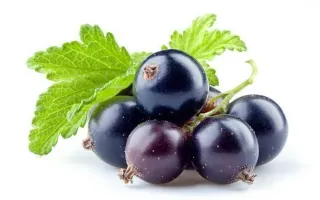
Berries are large (1.2-1.5 g), round and oval, black, slightly hairy, with medium gloss, smooth or occasionally with a constriction at individual berries, dry detachment. Contain a large number (57) of medium-sized seeds. Calyx is medium, closed, falling off and semi-falling off. Taste rating 4.7 points. Berries are of universal use. Chemical composition: dry soluble substances — 20.5%, sugar total — 12.6%, titratable acidity — 2.5%, ascorbic acid — 169.5 mg/100 g.
Winter-hardy, stable yielding (2.5 — 3.0 kg/plant), highly self-fertile. Shows resistance to powdery mildew and leaf spot diseases, weakly damaged by bud mites.
Advantages of the variety: high productivity, resistance to fungal diseases, high taste and market qualities of berries.
Crop & resistance
Crop
Disease resistance
Pest resistance
Specifications
| Type of Sort | |
|---|---|
| Catalog | Catalog → Currant |
Not yet комментариев. Be the first!
Alternatives
Currant saplings · similar varieties




See also
Often considered together with this variety






Recently viewed
Products you’ve viewed on this site
Reviews · 0