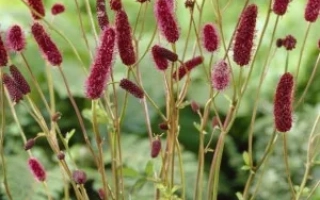
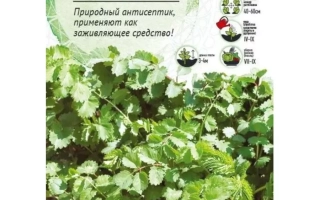
Lovage is a perennial herbaceous plant of the rose family, growing up to 90 cm tall and valued as an ornamental shrub and useful agricultural crop. Leaves are small, almost round with serrated edges, covered with short petioles; they have a strong cucumber aroma that disappears upon thermal treatment. Flowers are greenish in color, inflorescences are globular and bloom from May to June, while fruits – nuts – ripen in August, becoming dark brown.
Lovage is widely used as a medicinal plant. The rhizome and roots possess hemostatic, anti-inflammatory, bactericidal, and astringent properties; decoctions or extracts are applied for gastrointestinal diseases, intestinal, uterine, and renal bleeding, stomatitis, and gingivitis. In folk medicine, it is used to treat headaches, sore throats, stomach upset, and as a topical remedy for wound healing.
In cooking, lovage leaves are used as a seasoning in salads, soups, tomato, egg, and fish dishes, as well as for flavoring drinks and cocktails. Roots are boiled as a side dish to meat; roots and leaves are steeped and consumed as tea. Young leaves contain vitamin C and are used in preserving.
In agriculture, lovage is appreciated as a forage crop and also used in preservation and vinegar production. The plant grows easily on sandy, loamy, and calcareous soils; sowing is carried out early in the spring at a depth of 2–2.5 cm, with thinning according to a scheme of 20×45 cm. Harvest is collected during the budding period: after the first mowing, the plant can produce a second and under favorable conditions – even a third crop.
Lovage’s ornamental value comes from its lacy leaves, which adorn flower beds, as well as the ability to use dried leaves and rhizomes in dry bouquets. New varieties, such as ‘Rh-neg’, are characterized by late maturity and high yields – up to 1.1 kg/m².