


SKU #61513
·
30 views
Cabbage Pegas
Cabbage
Prices in stores
No offers yet — stores have not added prices for this product yet.
Similar varieties with prices
-
KantoIkasido Global Group B.V
from 7.45 €per 1000 seeds
-
 LOSIINOOSTROVSKAYA 8
from 0.13 €
LOSIINOOSTROVSKAYA 8
from 0.13 €
-
 KILACEESSyngenta
from 10.28 €per 1000 seeds
KILACEESSyngenta
from 10.28 €per 1000 seeds
-
 GOLDEN HECTARE 1432
from 0.87 €per 1000 seeds
GOLDEN HECTARE 1432
from 0.87 €per 1000 seeds
Plant Type
White cabbage
Direction
Fresh Market
Maturation (seedlings)
130-140 days
Head: shape
Round
Your mark
0 votes
0% positive ratings
Description
White cabbage 'PEGAS' is a mid-late hybrid developed by K.A. Timiryazev Moscow State Agricultural Academy and the All-Russian Vegetable Research Institute. The plant forms a spreading or semi-erect rosette of leaves 23–37 cm high and 44–92 cm in diameter, with 7 to 18 leaves. Leaves have a medium petiole, lyrate or indistinctly lyrate shape, pale green or light green color with a waxy coating of weak or medium intensity. The leaf margin is wavy, the surface is finely wrinkled, giving the plant a characteristic appearance.
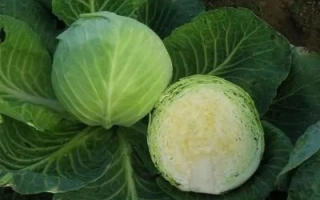
The heads of 'PEGAS' are round, very dense, 12–22 cm high, and weigh 2.7–4.2 kg. The external color is light green, and the head is white in cross-section. The covering leaf is smooth or slightly wrinkled, without anthocyanin. The length of the outer stalk is 8–16 cm, and the inner one is 6–8 cm. The cabbage has excellent taste qualities both fresh and when stewed and pickled. The dry matter content ranges from 7.6% to 10.3%, total sugar from 4.6% to 5.0%, ascorbic acid from 30.2 to 60.0 mg per 100 g of raw material, and protein from 0.8% to 1.3%.
The 'PEGAS' hybrid is recommended for cultivation using industrial technology and is distinguished by high commercial yield, which ranges from 6.6 to 9.5 kg/m², equivalent to 656–949 c/ha, and exceeds the standards of several known varieties. Technical maturity of heads occurs 136–158 days after full germination. The cabbage is resistant to gray mold and black root of seedlings, and has medium resistance to white stem. Thanks to these characteristics, 'PEGAS' is suitable for fresh consumption, pickling, stewing, and short-term storage.
The heads of 'PEGAS' are round, very dense, 12–22 cm high, and weigh 2.7–4.2 kg. The external color is light green, and the head is white in cross-section. The covering leaf is smooth or slightly wrinkled, without anthocyanin. The length of the outer stalk is 8–16 cm, and the inner one is 6–8 cm. The cabbage has excellent taste qualities both fresh and when stewed and pickled. The dry matter content ranges from 7.6% to 10.3%, total sugar from 4.6% to 5.0%, ascorbic acid from 30.2 to 60.0 mg per 100 g of raw material, and protein from 0.8% to 1.3%.
The 'PEGAS' hybrid is recommended for cultivation using industrial technology and is distinguished by high commercial yield, which ranges from 6.6 to 9.5 kg/m², equivalent to 656–949 c/ha, and exceeds the standards of several known varieties. Technical maturity of heads occurs 136–158 days after full germination. The cabbage is resistant to gray mold and black root of seedlings, and has medium resistance to white stem. Thanks to these characteristics, 'PEGAS' is suitable for fresh consumption, pickling, stewing, and short-term storage.
Crop & resistance
Crop
Specifications
| Plant Type | |
|---|---|
| Direction | |
| Maturation (seedlings) | 130-140 days |
| Head | |
| Shape | |
| Mass | 2.0-3.0 kg, 3.0-4.0 kg |
| Storage | 1-2 months |
| Registration year | 1996 |
| Catalog | Catalog → Cabbage |
| Legal data |
Show · 3 |
| Country | Russia |
No reviews yet. Be the first to share your experience.
Alternatives
Cabbage seeds · similar varieties


See also
Often considered together with this variety



Recently viewed
Products you’ve viewed on this site
Reviews