


SKU #61721
·
28 views
Otrada
Cabbage
User rating
0 votes0% positive reviews
No ratings yet — be the first.
Plant Type
Red Cabbage
Direction
Fresh Market
Maturation (seedlings)
120-130 days
Head / head; color
Purple
Prices in stores
from11.5 €per 1000 seeds
pack from 28.75 € per 2 500 pcs
1 offer from 1 store
Store offers · 1 from 1 stores
Prices are updated on loadLoading offers…
Available at: Agroterem
Aggregator catalog: prices are collected automatically from store websites, normalized by AI and converted at the current exchange rate. Before ordering, confirm the price and availability on the store's website. This block is not indexed by search engines — the data is loaded after the page opens.
About product

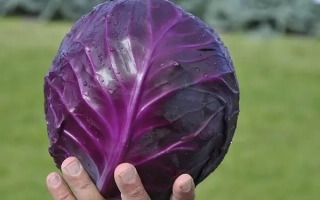
The OTRADA cabbage variety is a late-maturing red cabbage with a vertical rosette of leaves. The medium-sized leaves are purple in color with a pronounced waxy coating, weakly blistered, and weakly wavy edges. The head is oval-shaped, dark purple when cut, with short external and internal stalks. The average head weight is about 2 kg, and the taste is of high quality. The variety yields up to 7 kg…
Plant Type
Red Cabbage
Direction
Fresh Market
Maturation (seedlings)
120-130 days
Head / head; color
Purple
Description
The OTRADA cabbage variety is a late-maturing red cabbage with a vertical rosette of leaves. The medium-sized leaves are purple in color with a pronounced waxy coating, weakly blistered, and weakly wavy edges. The head is oval-shaped, dark purple when cut, with short external and internal stalks. The average head weight is about 2 kg, and the taste is of high quality. The variety yields up to 7 kg per square meter, making it attractive for cultivation in personal subsidiary holdings. The variety is resistant to fusarium wilt, which increases its reliability in various climatic conditions. OTRADA cabbage is recommended for fresh consumption, highlighting its versatility and excellent taste. Due to its late maturation period, it is suitable for cultivation in various regions, ensuring a stable harvest. For successful cabbage cultivation, it is important to consider agronomic requirements: the crop prefers fertile, moisture-retentive, and loose soils with a neutral or slightly alkaline reaction, growing especially well on loam and sandy-loam plots with good drainage and high organic matter content. The optimal temperature for growth and head formation is between +15 and +22 degrees Celsius. As a crop, cabbage is cold-hardy and can germinate at temperatures of +4...+5 °C, while adult plants can withstand temperatures down to -2...-3 °C. To obtain a high yield, it is recommended to observe crop rotation, avoiding planting cabbage after other cruciferous crops to reduce the risk of disease and pest accumulation. Ideal predecessors include potatoes, onions, carrots, tomatoes, and cucumbers. The OTRADA variety, thanks to its characteristics and disease resistance, is an excellent choice for cultivation in various climatic zones.
Crop & resistance
Crop
Disease resistance
Specifications hover over for a hint about the specification
| Plant Type | |
|---|---|
|
Direction
Direction
Existing varieties and types of cabbage are grown for fresh consumption, long-term storage, and technical processing. |
|
|
Maturation (seedlings)
Maturation (seedlings)
By the length of the vegetation period, cabbage varieties are conditionally divided into three maturity groups: early maturing (100 — 120 days), mid-season maturing (120 — 150 days), and late maturing (more than 150 days). When sowing cabbage seeds in March — April, cabbage seedl... |
120-130 days |
|
Head / head; color
Head / head; color
The color of the head / head depends on the genetic characteristics of the specific cabbage variety. It can vary from light green to dark purple. |
|
|
Head / Head; shape
Head / Head; shape
The head shape depends on the cabbage variety. Thus, in white-headed, red-headed, and savoy cabbage, it is round or flat-round, in colored cabbage — compact, and in Peking cabbage — barrel-shaped. |
|
|
Cabbage head; mass
Cabbage head; mass
The mass of the cabbage head depends on the variety characteristics and cultivation techniques. It can reach 10 kg and even more. |
1.0-2.0 kg |
|
Storage
Storage
Depending on the variety characteristics, the storage period for heads may vary from one month for early varieties to eight months for late cabbage varieties. |
3-6 months |
| Registration year | 2010 |
| Catalog | Catalog → Cabbage |
| Legal data |
Show · 5
|
| Country | Russia |
Not yet комментариев. Be the first!
Alternatives
Cabbage seeds · similar varieties




See also
Often considered together with this variety






Recently viewed
Products you’ve viewed on this site
Reviews · 0