


SKU #3559
·
328 views
Uralskiy suvenir
Apple
User rating
0 votes0% positive reviews
No ratings yet — be the first.
Type of Sort
Winter Apple Variety
About product

Winter variety from the Sverdlovsk Experimental Garden Station. Obtained by crossing the varieties Udarница and Ural Large. Authors: L. A. Kотов, P. A. Диброва. Approved for the Volga-Vyatka region, which includes the Middle Urals areas (Perm and Sverdlovsk regions). Distributed also on the Southern Urals.
Strong-growing tree with a high oval-pyramidal crown. Main branches with reddish-brown b…
Type of Sort
Winter Apple Variety
Description
Winter variety from the Sverdlovsk Experimental Garden Station. Obtained by crossing the varieties Udarница and Ural Large. Authors: L. A. Kотов, P. A. Диброва. Approved for the Volga-Vyatka region, which includes the Middle Urals areas (Perm and Sverdlovsk regions). Distributed also on the Southern Urals.
Strong-growing tree with a high oval-pyramidal crown. Main branches with reddish-brown bark, branch out from the trunk at an angle close to straight, pointing upward, well covered with spurs and fruiting shoots, on which fruiting is mainly concentrated. Flower buds are formed frequently on last year's growth.
Shoots with reddish-brown bark, slightly curved, straight, slightly grooved. Leaves bright green, glossy, without hairs, elongated oval-egg-shaped, with a rounded base, broadly wedge-shaped tip, with small serrated or serrate-toothed edges, short petioles, and small lanceolate bracts.
Flowers large, conical, white, stigma stigmas positioned above the anthers. Buds pink.
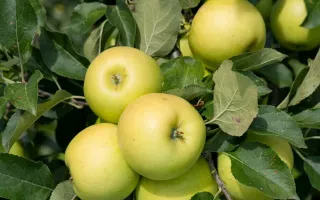
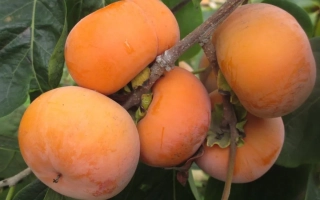
Fruits of medium size, weighing 75-100 g, one-dimensional, regular round shape, ribs not visible. Skin smooth. Main color — light yellow, covering — blurred or blurred-striped, rather bright blush on most of the fruit. Rust small, golden-brown, attractive appearance. Fruit stalk very long, medium thickness, often with a bud in the middle, thicker base. Pit very small, wide, often "swollen" with formation of short pear-shaped neck. Dish small, calyx open, calyx lobes long. Subcalyx tube medium size, conical. Axial cavity absent, seed chambers closed, heart bulbous.
Flesh with yellowish hue, slight reddening near skin, juicy, pleasant sour-sweet flavor. Chemical composition: soluble solids — 16.0 (up to 20.1)%, total sugars — 11.8 (up to 134.3)%, titratable acids — 0.66 (up to 1.33)%, ascorbic acid — 24.2 (up to 36.0) mg/100g, P-active substances (catechins) — 244.6 (up to 393.8) mg/100g.
Fruits ripen in early September and remain until 120 days. At ripening, fruits do not drop off, well tolerate transportation; good for fresh consumption, suitable for processing into juices, compotes, jams, etc.
Variety is early-bearing, begins fruiting in the 4th-5th year or earlier. Yields are regular. Winter hardiness is high. Variety is not resistant to scab — in wet years may be significantly affected by it.
Advantages of the variety: winter hardiness, early bearing, high yield, suitability for fresh consumption and various processing methods.
Disadvantages of the variety: susceptibility to scab.
Uralskiy suvenir variety reliably transmits its morphological traits to offspring. A number of valuable elite seedlings have been obtained from crossing with it, including those resistant to scab (Vem-souvenir, Vem-pink, etc.).
Video · 2 videos
Suggest a video →Crop & resistance
Crop
Specifications
| Type of Sort | |
|---|---|
| Catalog | Catalog → Apple |
Store offers
Prices are updated on loadLoading offers…
Aggregator catalog: prices are collected automatically from store websites, normalized by AI and converted at the current exchange rate. Before ordering, confirm the price and availability on the store's website. This block is not indexed by search engines — the data is loaded after the page opens.
Not yet комментариев. Be the first!
Alternatives
Apple saplings · similar varieties



See also
Often considered together with this variety


Recently viewed
Products you’ve viewed on this site
Reviews · 0