


SKU #3270
·
244 views
Alpinist
Apple
User rating
0 votes0% positive reviews
No ratings yet — be the first.
Type of Sort
Winter Apple Variety
Tree; Growth Power
Tall
Tree; Canopy Shape
Flat-rounded crown
Fruit; Fruit Shape
Flat-round
Store offers · 3 from 3 stores
Prices are updated on loadLoading offers…
Available at: LeafLand · Sadovnikoff · Smartsad
Aggregator catalog: prices are collected automatically from store websites, normalized by AI and converted at the current exchange rate. Before ordering, confirm the price and availability on the store's website. This block is not indexed by search engines — the data is loaded after the page opens.
About product

Late-winter variety selected by the North Caucasus Research Institute of Mountain and Piedmont Horticulture. Obtained by hybridizing Renet Simirenko with Pepin Chernenko. Author: P. P. Kostyk. Approved for cultivation in the Kabardino-Balkar Republic. Efficiently cultivated in all republics and regions of the North Caucasus. Occupies large areas in Moldova and Ukraine.
Strong-growing tree. Yo…
Type of Sort
Winter Apple Variety
Tree; Growth Power
Tall
Tree; Canopy Shape
Flat-rounded crown
Fruit; Fruit Shape
Flat-round
Description
Late-winter variety selected by the North Caucasus Research Institute of Mountain and Piedmont Horticulture. Obtained by hybridizing Renet Simirenko with Pepin Chernenko. Author: P. P. Kostyk. Approved for cultivation in the Kabardino-Balkar Republic. Efficiently cultivated in all republics and regions of the North Caucasus. Occupies large areas in Moldova and Ukraine.
Strong-growing tree. Young crown is round or flat-round, with hanging, thin, moderately dense branches at the base. In full fruiting, crown is spreading and broadly round. Trunk has smooth, light-gray bark. Main branches are light-gray, thin, inclined-vertical, drooping with age. Predominant fruiting structures are simple, complex rings, short and long fruiting spurs.
Medium-thickened shoots, light-gray, straight with long internodes. Leaves green, shiny, medium-sized, elongated, curved upward, with serrated edges, long petioles, hairy.
Flowers large, small-cup-shaped, white with pinkish tinge, with long hairy stigmas, stigma higher than anthers.
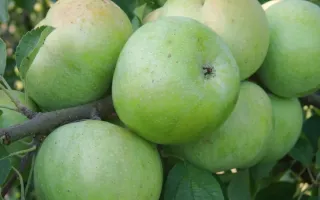
Fruits above-average size (168 g), one-dimensional, round-oval shape, with weakly expressed ribbing. Skin smooth and glossy. Main color at harvest maturity — green, at consumer maturity — light-yellow with well-defined subcutaneous dots. Peduncle short and thick. Seed chambers closed, with medium-sized, oval, brown seeds. Receptacle tube short, medium-sized, reverse-conical.
Flesh greenish-yellow, firm, fine-grained, very juicy, sweet-sour flavor with slight aroma. Fruit contains: sugars — 8.6%, titratable acids — 0.75%, ascorbic acid — 7.9 mg/100g.
Late-winter ripening (can be stored until May). Fruit production begins on 3rd–4th year. High yield, fruiting periodicity is not strongly expressed. Winter hardiness is medium, comparable to Renet Simirenko. Variety is weakly resistant to scab and powdery mildew.
Advantages of the variety: high productivity, excellent commercial quality, long storage life while preserving firm, detachable flesh and fruit flavor.
Disadvantages of the variety: weak winter hardiness, susceptibility to scab, and exposure of long branches inside the crown.
Video · 1 video
Suggest a video →Crop & resistance
Crop
Specifications hover over for a hint about the specification
| Type of Sort | |
|---|---|
| Tree; Growth Power | |
| Tree; Canopy Shape | |
| Fruit; Fruit Shape | |
|
Fruit; flesh color
Fruit; flesh color
Color of the fruit flesh. There are red, pink, yellow, and brown colors. |
|
| Fruit; Fruit Color (Base Color) | |
| Fruit; Fruit mass | 168 |
| Fruit; Lying | 8 |
| Cold Resistance | |
| Catalog | Catalog → Apple |
Not yet комментариев. Be the first!
Alternatives
Apple saplings · similar varieties




See also
Often considered together with this variety




Recently viewed
Products you’ve viewed on this site
Reviews · 0