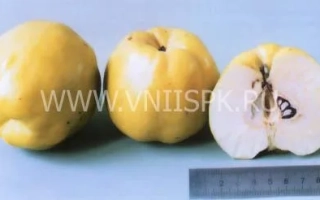
Introduced at the Stavropol Experimental Station for Horticulture. Breeders: A.I. Seredenko and V.V. Starikh. Obtained by crossing the selected form Zherdeli and the late variety Krasnochekiy. Regionally approved in the Stavropol Krai in 2000.
Tree above average size, crown shape flat-round, raised, medium density, well-leafed. Skeletal branches long, medium density, mostly straight, reddish-brown. Leaf large, broad, inversely egg-shaped, dark green, smooth, slightly shiny. Flower large, solitary, white, with a pleasant aroma. Bears fruit on one-year-old growth and shortened shoots (shorches).
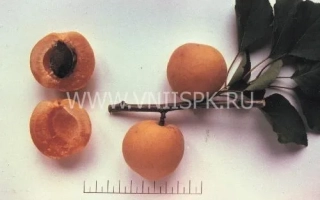
Fruits large, one-dimensional, oval-round shape, slightly compressed on sides. Fruit mass 48-50 g. Main fruit color light-yellow, covering pale carmine. Flesh golden-yellow with whitish tinge, firm, juicy, sweet, weakly acidic, easily separates from the stone. Skin slightly hairy, downy with weak waxy coating, does not peel off the fruit. Stone medium, inversely egg-shaped, pointed, easily separates from flesh. Seed bitter. Peduncle short, medium thickness, firmly attached to stone. Fruits contain 17.3% dry matter, 13.5% sugars, 1.2% acids.
Flowers in mid-season, over 5-7 days, partially self-fertile. Best pollinators: Krasnochekiy, Orlik Stavropol, Reklamny. Medium-late ripening variety. Fruits ripen at the end of the third decade of July, 2-3 days later than Krasnochekiy. Fruits transportable, versatile use.
Early fruiting variety. Trees grafted onto peach, enter fruiting 3-4 years after planting. Yield at 7-8 years old 40-45 kg/tree, at 10-11 years — 75-80 kg/tree.
Winter hardiness of trees and flower buds is sufficiently high. Resistant to clasterosporiosis and moniliosis. Drought-tolerant. Prefers calcareous chernozems, multi-clay and gray forest soils with elevated relief elements. Requires light, warmth and moisture. Responsive to fertilizer application. Requires disease and pest control measures. Preferred pruning is improved sparse tiered crown. Due to vigorous growth, limiting pruning is necessary, followed by switching the leader to a lateral branch.
Advantages of the variety: valued for early fruiting, high winter hardiness of flower buds, all buds and trees, resistance to clasterosporiosis and monilial burn, late ripening, large fruits with high taste and preservation qualities.
Disadvantages of the variety: trees above average size, fruits become smaller under heavy fruit load. Partially self-fertile — requires companion planting with pollinator varieties for normal fruiting. Seed bitter.