
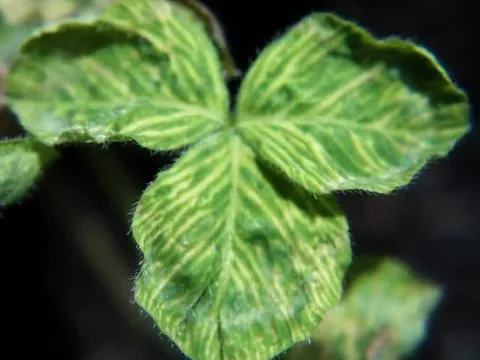
Clover mottle virus
Sobemovirus trov
The causative agent of the disease is the Clover mottle virus (ClMoV), belonging to the genus Sobemovirus. It is a small, isometric, RNA-containing virus known for its high stability in the environment.
What the section contains
Clover mottle virus
The virus primarily affects perennial leguminous grasses, including various clover species (red clover, white clover) and other related plants of the Fabaceae family.
In nature, the infection is transmitted mainly through mechanical contact, as well as by specialized insect vectors, such as beetles and weevils.
The incubation period of the virus depends on ambient air temperature and the physiological condition of the host plant, typically ranging from a few days to several weeks.
The virus can persist in the roots of perennial plants throughout the winter season, serving as a primary source of infection for new growth in the spring.
The primary symptom of the disease is the appearance of characteristic mottling on clover leaves, manifesting as light green or yellowish spots and a mosaic pattern.
Infected plants often exhibit deformation of leaf blades, curling, and a general reduction in size compared to healthy specimens.
Under conditions of severe infection, stunted growth and development are observed, which leads to a thinning of the stand in pastures or hayfields.
Symptoms may be masked during hot weather, but under favorable conditions for the virus, chlorotic manifestations become clearly visible.
External signs are often accompanied by a decrease in photosynthetic intensity, which negatively affects the plant's biomass accumulation.
The disease leads to a significant reduction in green mass and hay yields, which directly affects the nutritional quality of clover crops in agriculture.
Viral infection reduces the winter hardiness of plants, leading to a decline in stand density and necessitating premature reseeding of the fields.
Clover mottle virus impairs the nitrogen-fixing capacity of the leguminous root system, thereby lowering the natural soil fertility in fields where the crop is grown.
Economic losses are also incurred due to the loss of seed quality, as infected plants produce fewer seeds with lower germination rates.
Widespread dissemination of the virus can render the cultivation of clover as a primary forage crop unprofitable for specialized farms.
Virus development is favored by optimal temperatures in the range of 18–25 degrees Celsius, which are conducive to the active reproduction of insect vectors.
High air humidity also indirectly facilitates the spread of the infection by ensuring high pest population densities in the field.
The high frequency of mechanical damage to plants (during mowing or livestock grazing) facilitates the entry of the virus into clover tissues through micro-wounds.
The presence of weeds that act as virus reservoirs during the off-season significantly accelerates the epiphytotic process.
Continuous cultivation of clover on the same fields for many years creates conditions for the accumulation of the inoculum in the soil and plant roots.
A key method of prevention is the use of virus-resistant clover varieties, with breeding programs focusing on suppressing viral replication.
Strict adherence to crop rotation is necessary, avoiding the cultivation of leguminous grasses on the same plot for more than 3–4 consecutive years.
An important aspect of protection is the control of insect vectors (such as beetles and weevils) using authorized insecticidal treatments.
Timely identification and removal of infection foci and host weeds, which may serve as additional sources of the virus, are highly recommended.
Adhering to optimal mowing schedules and proper grazing management helps reduce the number of mechanical injuries through which the virus enters the plant.