
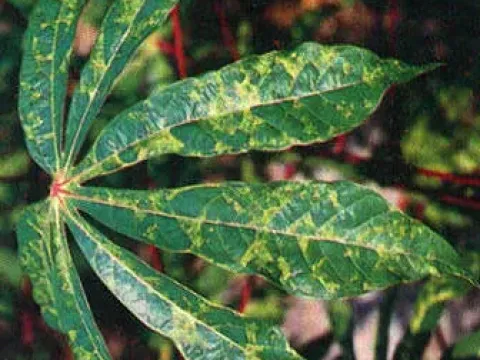
Cassava mosaic
Ipomovirus manihotis
The disease is caused by the Cassava mosaic virus (CMV), which is a member of the Ipomovirus genus within the Potyviridae family. It is a systemic viral pathogen that infects the plant's vascular tissue.
What the section contains
Cassava mosaic
The virus disrupts the plant's metabolic processes and photosynthetic efficiency. It can be transmitted via infected cuttings, which are commonly used for vegetative propagation in cassava cultivation.
Pathogen biology involves high adaptation to host environments, facilitating persistence across growing seasons. Understanding the viral structure is essential for diagnostic developments and breeding programs.
The infection is systemic, meaning the virus spreads through the entire plant body, including leaves, stems, and the root system. This persistence makes it difficult to cure individual plants once they are infected.
The whitefly, Bemisia tabaci, serves as the primary vector. The insect acquires the virus while feeding on infected leaves and transmits it to healthy plants, making the vector control a crucial part of disease management.
The most prominent symptoms include a mosaic pattern on the leaves, characterized by chlorotic patches mixed with darker green areas. These patterns are typically most visible on young, expanding leaves.
Leaves often appear stunted, distorted, and crinkled, significantly reducing the surface area available for photosynthesis. This leads to a marked reduction in plant vigor and overall growth.
Infected plants often exhibit a bushy, stunted appearance with shortened internodes. This deviation from the normal morphological structure makes the affected plants easily identifiable in the field.
The root system of diseased plants is poorly developed, leading to a significant decrease in the number and size of storage tubers. The yield reduction is a direct consequence of the limited carbohydrate supply to the roots.
In severe cases, the plant may show necrosis at the leaf tips or premature senescence. These visual cues serve as early warning signs for farmers to take containment actions.
Disease outbreaks are favored by hot and humid tropical climates, which provide optimal conditions for the rapid multiplication of the whitefly population. High temperatures accelerate the transmission cycle.
Weed infestation in and around fields acts as a reservoir for both the virus and the insect vector. Proper field sanitation is crucial to reduce the inoculum level in the environment.
Planting density plays a significant role in disease spread. Dense canopy conditions facilitate the movement of whiteflies between plants, significantly increasing the probability of widespread infection.
The use of infected cuttings as planting material is the primary driver for long-distance spread of the virus. If the mother plant was infected, the subsequent cuttings will inevitably carry the pathogen.
Environmental stress, such as prolonged drought or nutrient deficiency, can make the plants more susceptible to viral infections, as their natural defense mechanisms are compromised.
The economic impact of cassava mosaic is immense, as it leads to substantial yield losses that can range from 40% to over 90% depending on the cultivar susceptibility and time of infection.
Beyond quantity, the quality of the harvested tubers is also compromised. The starch content is often lower, and the tubers may be smaller and less suitable for food processing or industrial use.
The inability to use home-saved seeds is a major economic burden on smallholder farmers. They are forced to invest in clean, certified planting material, increasing the cost of production.
Affected plants are often more vulnerable to secondary infections, such as root rot caused by fungi or bacteria. This shortens the post-harvest shelf life of the tubers and increases storage losses.
The disease poses a serious threat to food security in regions that depend on cassava as a staple crop. Large-scale outbreaks can destabilize local agricultural economies.
The primary strategy for control is the use of disease-free, certified planting material. Sourcing cuttings from verified clean nurseries is the most effective way to prevent introduction of the virus.
Managing the whitefly vector population is essential to reduce the rate of new infections. This involves the timely application of insecticides or the use of biological control agents.
Breeding and planting resistant or tolerant cassava varieties is the most sustainable long-term solution. Researchers focus on developing hybrids that can withstand the virus even if infected.
Rogueing, or the immediate removal and destruction of symptomatic plants, helps to lower the pathogen load in the field. This practice should be performed continuously throughout the growing season.
- Maintaining adequate field hygiene and weed control.
- Implementing spatial isolation between newly planted fields and older crops.
- Training farmers in recognizing and managing early infection signs.
- Sterilizing pruning tools after use on suspect plants.