
Cassava mosaic virus
Nepovirus manihotis
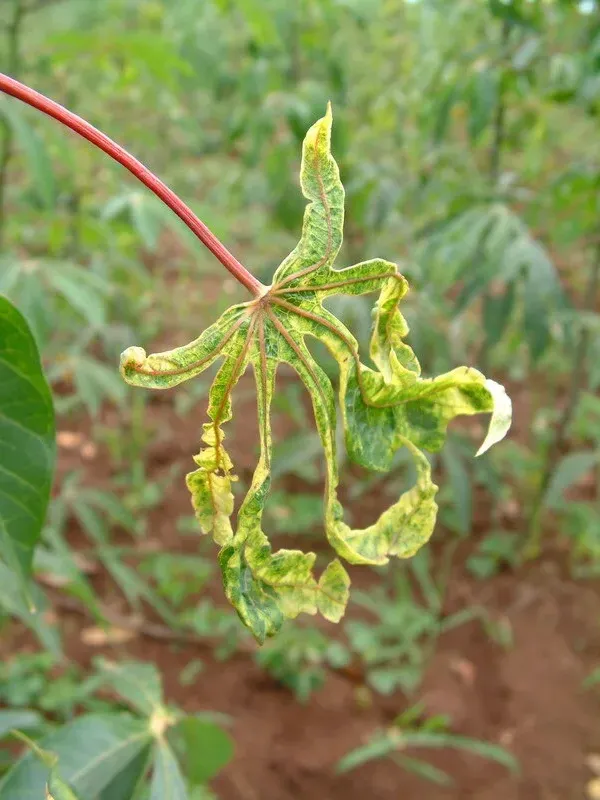
Description
Symptoms
The primary symptom of Cassava mosaic virus infection is the development of a distinct mosaic pattern on the leaves. The leaf blades exhibit chlorotic spots, alternating between light green, yellow, and dark green areas, which disrupt the plant's normal pigmentation.
Beyond color changes, affected plants often show significant leaf distortion. The leaves may become wrinkled or crinkled, their edges may curl, and the overall surface area is reduced, directly impacting the plant's ability to perform photosynthesis.
Infected plants display a clear stunting in their growth. The stems become thin and brittle, and the overall biomass of the plant is drastically reduced, which is a hallmark of the systemic nature of this viral disease.
The impact extends to the root system, where the tubers—the main commercial part of the crop—often fail to develop properly. Tubers remain small, underdeveloped, and frequently show deformities that make them unmarketable.
Symptoms may vary depending on the specific cassava cultivar and local environmental conditions. Early detection is often difficult but critical for managing the disease in commercial plantations.
Pathogen
The causative agent is the Nepovirus manihotis, which belongs to the Nepovirus genus. These pathogens are characterized by their single-stranded RNA structure and spherical particle morphology, typical of this viral family.
The disease is classified as a systemic viral infection, meaning the virus colonizes the plant's vascular tissues and spreads throughout the entire organism, utilizing host cell mechanisms for its replication.
The biology of the virus is deeply linked to its transmission efficiency. It can persist in infected plant tissues for long periods, making vegetative propagation a major pathway for the disease's survival and spread.
As a systemic pathogen, Nepovirus manihotis disrupts the hormonal balance and metabolic pathways of the cassava plant, leading to the characteristic phenotypic changes observed in infected fields.
The stability of the virus particles ensures that they can remain infectious under various conditions, provided they are sheltered within the plant host or, in some cases, protected by vector organisms.
Conditions for development
Transmission of the virus is heavily influenced by the presence of soil-borne vectors, particularly certain species of nematodes. These organisms feed on plant roots and effectively transmit the virus from one plant to another.
The use of infected cuttings for vegetative propagation is the most significant factor in the long-distance spread of the virus. Planting material from an infected mother plant virtually guarantees the persistence of the disease.
Favorable climate conditions, particularly warmth, stimulate the activity of both the nematode vectors and the viral replication processes within the plant tissue, accelerating the onset of infection.
Mechanical transmission is another critical pathway. Farm tools, such as pruning shears or harvesting knives, can transfer the virus if they are contaminated with the sap of infected plants and not properly cleaned between uses.
Soil moisture levels are essential for the survival and movement of soil-dwelling nematodes. Sufficient moisture supports the migration of these vectors, thereby increasing the likelihood of widespread field infection.
Why it matters
Cassava mosaic virus poses a severe threat to global food security, as cassava remains a staple starch source for hundreds of millions of people in tropical and subtropical regions.
The economic impact is primarily driven by substantial yield losses. Because the foliage is damaged, the plant's capacity for starch accumulation is severely impaired, resulting in lower tuber production.
Beyond yield quantity, the quality of the harvest is compromised. Tubers from infected plants may have altered starch composition, making them less suitable for consumption or industrial starch production.
Viral infection leaves the plants in a weakened state, making them highly susceptible to secondary attacks by other pathogens like fungal rots or bacterial infections, further exacerbating crop losses.
The systemic nature of the infection means that once a plant is infected, it cannot be cured. This necessitates the total removal of infected plants, leading to additional labor costs and management challenges for farmers.
Protection
The most effective strategy is the use of healthy, virus-free planting material. Establishing certified nurseries that provide clean cuttings is crucial for maintaining disease-free plantations.
Rigorous field monitoring and the rapid roguing (removal and destruction) of symptomatic plants help prevent the secondary spread of the virus throughout the field.
Sanitation of agricultural tools is vital. All cutting equipment should be disinfected with appropriate solutions between plants to stop mechanical transmission of the virus.
Managing soil vector populations through crop rotation and the application of targeted soil treatments can significantly reduce the infection pressure on new plantings.
- Strict quarantine regulations for plant material movement.
- Development and distribution of virus-resistant cassava cultivars.
- Implementation of balanced fertilization to strengthen plant immunity.
Discussion
No discussions yet — be the first.