
Cassava mosaic begomovirus
Begomovirus manihotisindianense
Description
Symptoms
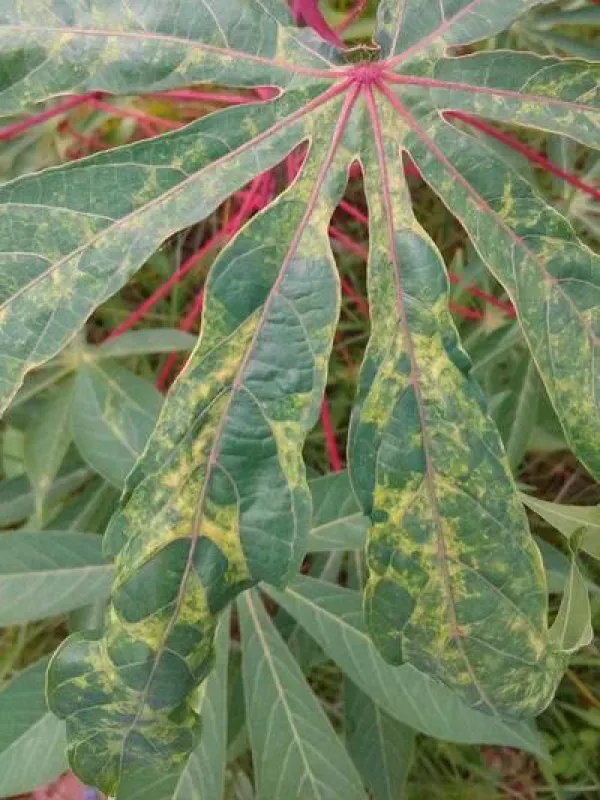
The most visible symptom is a distinct mosaic pattern on the leaves, featuring irregular patches of light green, yellow, and dark green discoloration.
Leaf morphology is often severely affected, showing curling, twisting, or the development of thin, distorted leaf blades that reduce photosynthesis.
Stunted growth is a common indicator, with infected plants failing to reach the height and vigor of healthy neighboring plants in the field.
Excessive branching and shortening of internodes can lead to a bushy appearance, commonly referred to as the 'witch's broom' effect in severe cases.
Underground, the root system is stunted, resulting in the production of fewer and smaller tubers, which significantly reduces total harvestable weight.
Pathogen
The causative agent of this disease is a virus belonging to the genus Begomovirus within the Geminiviridae family, characterized by a single-stranded DNA genome.
The viral particles exhibit a typical geminate morphology, consisting of two fused incomplete icosahedral shells, which is a hallmark of this viral group.
The primary vector responsible for the transmission of the virus is the whitefly (Bemisia tabaci), which transmits the pathogen during feeding.
Beyond vector transmission, the virus is frequently spread through the use of infected cuttings during vegetative propagation of the crop.
Once inside the host, the virus spreads systemically through the phloem, disrupting physiological and metabolic functions throughout the plant.
Conditions for development
Development is favored by tropical climates, where consistent heat and humidity facilitate the rapid lifecycle of the whitefly vector.
High population densities of the whitefly in agricultural landscapes significantly accelerate the rate of virus spread across plantations.
The presence of alternative weed hosts in or near the fields provides a reservoir for the virus, allowing it to persist throughout the year.
Poor ventilation and overcrowded planting conditions favor the movement and colonization of whiteflies on the lower surfaces of leaves.
Using infected plant material as a primary source for propagation ensures the establishment of the disease at the very beginning of the season.
Why it matters
The main economic impact is a drastic reduction in tuber yield, which can exceed 50% in highly susceptible varieties under high infection pressure.
The overall quality of the cassava tubers is compromised, rendering the harvest less valuable for both human consumption and industrial starch production.
The debilitated state of the plants makes them more susceptible to other secondary infections and environmental stressors.
The disease poses a long-term threat to farm viability, often forcing farmers to abandon fields or switch to different varieties entirely.
The cumulative loss includes not only the reduction in yield but also the high costs associated with pest control and farm sanitation programs.
Protection
Developing and deploying resistant or tolerant cassava cultivars is the most effective and sustainable strategy for managing this disease.
Strict implementation of phytosanitary protocols, including the selection of virus-free cuttings for propagation, is essential for prevention.
Systematic scouting and the rogueing (removal) of symptomatic plants help to reduce the inoculum load within a plantation.
Integrated Pest Management (IPM) focusing on whitefly population control helps to prevent transmission and reduce the spread of the virus.
Maintaining a spatial buffer between new plantings and older, infected fields minimizes the migration of viruliferous whiteflies to young crops.
Discussion
No discussions yet — be the first.