
Cassava Cameroon mosaic
Begomovirus manihotiscameroonense
The disease is caused by Begomovirus manihotiscameroonense, a member of the Geminiviridae family. This virus is a significant agricultural pathogen affecting cassava crops in specific tropical regions.
What the section contains
Cassava Cameroon mosaic
The virus is transmitted by the whitefly Bemisia tabaci. This insect vector acquires the virus while feeding on infected plant tissues and subsequently transmits it to healthy cassava plants during feeding.
The virus particles are characterized by a unique geminate structure. Once inside the plant host, the virus moves systemically, hijacking the host's cellular machinery to replicate its single-stranded DNA genome.
This begomovirus is highly host-specific, primarily infecting plants of the Manihot genus. Its biological cycle is deeply intertwined with the population dynamics of its whitefly vector.
Genetic analysis shows that the virus possesses a multipartite genome, which contributes to its high rate of mutation and ability to overcome resistance in some local cassava landraces.
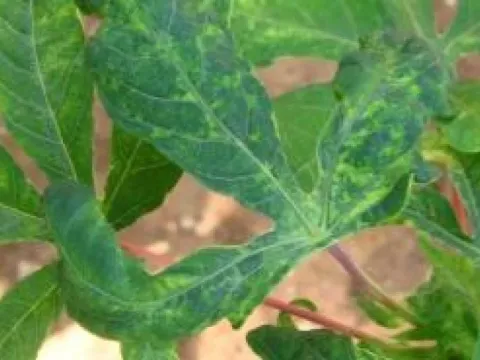
The most prominent symptom is a distinct chlorotic mosaic pattern on the leaves, characterized by irregular patches of yellow or pale green tissue against the healthy green background.
Infected cassava plants exhibit significant stunting. The overall growth is severely restricted, and the stems often appear shorter than those of non-infected counterparts of the same age.
Leaf distortion is common, where the laminae become crinkled, curled, or misshapen. This reduction in leaf surface area directly impacts the plant's photosynthetic capacity.
The shortening of internodes, often referred to as "shortening of the stem," gives the plant a bushy appearance, which is a classic diagnostic feature of this viral infection.
- Chlorotic mosaic patterns on leaves.
- Significant plant stunting.
- Leaf curling and deformation.
- Shortened internodes.
- Reduced root tuber development.
Tropical climates with high ambient temperatures and consistent humidity create optimal conditions for the proliferation of Bemisia tabaci, the primary vector of the virus.
Poor agricultural practices, such as the continuous planting of cassava on the same land without fallow periods, help maintain a steady source of the virus inoculum.
The presence of nearby weed hosts, particularly those that can harbor the whitefly vector, ensures that the viral cycle continues even when commercial crops are not present.
Increased human activity, including the transport of infected planting material (cuttings) between regions, is the primary driver of the long-distance spread of the disease.
High-density planting, which facilitates the movement of whiteflies between adjacent plants, significantly accelerates the spread of the virus within a field once an initial infection occurs.
The primary impact of the disease is a drastic reduction in root tuber yield. Because the plant's metabolic energy is redirected by the virus, tubers remain small and poor in starch.
The crop suffers from poor quality, making the tubers less desirable for both local consumption and industrial processing, which leads to significant financial losses for farmers.
In severe epidemic years, the infection can cause near-total crop failure, creating severe economic hardship for smallholder farmers who rely on cassava as their staple crop.
The disease weakens the plants, making them more susceptible to subsequent attacks by secondary pests and various soil-borne root rot pathogens, further exacerbating the yield loss.
Long-term consequences include the depletion of healthy germplasm and the need for costly interventions to replace infected stocks with disease-free materials.
The most effective strategy for managing Cassava Cameroon mosaic is the development and adoption of virus-resistant and tolerant cultivars through selective breeding programs.
Strict phytosanitary practices are essential, specifically the selection and use of healthy, disease-free cuttings for propagation to prevent the introduction of the virus into new areas.
Implementing integrated pest management (IPM) to control whitefly populations, including the use of targeted insecticides, is necessary in regions with high disease pressure.
Rogueing, the process of identifying and immediately destroying infected plants, is vital to prevent the secondary spread of the virus to healthy plants within the same field.
Crop rotation and maintaining a fallow period can help break the cycle of the virus by reducing the local population of vectors and limiting the availability of infected host tissue.