
Cassava witches' broom
Cassava witches
Cassava witches' broom is a devastating plant disease caused by phytoplasmas. These are specialized prokaryotic organisms that lack cell walls and reside strictly within the phloem sieve tubes of the host plant.
What the section contains
Cassava witches' broom
The phytoplasma acts as an obligate parasite, severely disrupting the plant's vascular system and interfering with the translocation of sugars and nutrients from leaves to roots.
In the field, the pathogen is transmitted from diseased to healthy plants by sucking insect vectors, most notably leafhoppers, which ingest the bacteria while feeding on plant sap.
A significant pathway for the dissemination of the disease is the use of infected cuttings for propagation. Since cassava is mainly grown vegetatively, this mechanism ensures the rapid spread of the pathogen to new farms.
The pathogen is highly systemic, meaning that once a cutting is infected, the phytoplasma colonizes all developing tissues, making the plant a chronic source of inoculum.
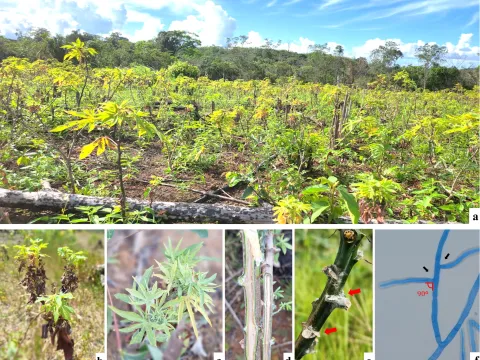
The most diagnostic symptom is the proliferation of shoots, resulting in dense, broom-like clusters of thin, stunted branches at the apex of the stem.
Leaves on the affected branches are typically smaller than normal, often show chlorosis (yellowing), and may exhibit cupping or other deformities due to hormonal imbalance.
The disease causes significant shortening of internodes, leading to a dwarf growth habit that makes the plant appear stunted and unthrifty compared to healthy specimens.
Root development is severely compromised; the plants produce few, if any, starchy storage roots, rendering the crop useless for harvest and consumption.
Vascular browning and necrosis can often be observed in cross-sections of the stems, reflecting the damage inflicted on the conductive tissues by the phytoplasma.
The prevalence of the disease is closely tied to the seasonal activity of insect vectors, which thrive in warm tropical environments with moderate to high humidity.
Weed species acting as alternative hosts for both the phytoplasma and the leafhoppers create a continuous cycle of infection near agricultural fields.
Poor agricultural practices, such as failing to screen parent material before propagation, allow the disease to persist and amplify over consecutive growing cycles.
Environmental stress, such as prolonged drought followed by heavy rain, can affect the vigor of the plant and influence the population dynamics of the insect vectors.
The proximity of newly planted fields to abandoned or already infected cassava plots is a major factor in the rapid spread of the witches' broom symptom.
The primary economic impact is the total loss of marketable root yield. In severe cases, farmers may lose entire fields, which threatens food security in regions dependent on cassava.
The systemic nature of the disease makes it a long-term problem for the farm, as infected plants cannot be "cured" and must be replaced entirely with healthy stocks.
The high cost of replacing the planting material, combined with expenses for vector control, puts significant financial pressure on smallholder farmers.
The degradation of starch content in the roots of infected plants, even if some growth occurs, makes them undesirable for processing into flour or other cassava-based products.
Widespread outbreaks can destabilize regional production systems, leading to a decrease in the availability and affordability of this staple carbohydrate crop.
The most important control strategy is the use of clean, certified planting material. Cuttings should be sourced from healthy parent stocks or produced via tissue culture.
Regular monitoring of fields for the presence of leafhoppers and the application of systemic insecticides are necessary to reduce vector populations and minimize secondary spread.
Strict sanitation measures, including the immediate rogueing (removal) and destruction of symptomatic plants by burning, are essential to stop the spread of the pathogen.
Maintaining a weed-free environment around the cassava plantation reduces the presence of reservoir hosts that harbor both the phytoplasma and the insect vectors.
Breeding for genetic resistance is considered the long-term solution for managing the disease, along with establishing effective regional quarantine policies for plant movement.