
Carrot red leaf virus
Polerovirus cldv
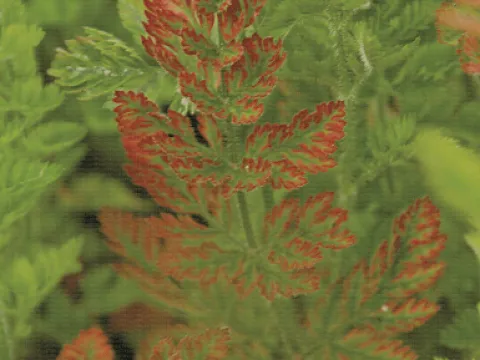
The primary symptom of infection is a distinct reddening or yellowing of the carrot leaves, which begin to curl inward. Plants show significant stunting, and the foliage becomes rigid and brittle, developing an unnatural reddish hue.
What the section contains
Carrot red leaf virus
Examination of the taproots reveals underdevelopment; they remain small, misshapen, and exhibit reduced eating quality. Initially, symptoms may be subtle, but as the disease progresses, the entire canopy takes on a stunted, bushy appearance.
Roots may develop abnormal branching, and internal vascular bundles can turn brown. The severity of symptom expression depends heavily on the plant's growth stage at the time of initial infection and the specific cultivar's resistance level.
Visual diagnosis is often challenging due to symptom overlap with nutrient deficiencies or soil-borne pest damage. Laboratory diagnostics are required to confirm the presence of viral particles in infected tissues.
In the field, infection patches typically manifest as clusters of stunted plants that gradually expand across the plot. Once infected, plants are virtually incapable of full recovery or normal energy storage.
The causative agent is the Carrot red leaf virus, belonging to the genus Polerovirus. This pathogen is highly specialized, primarily affecting plants within the Apiaceae family and disrupting their vital physiological functions.
The virus is not mechanically transmissible, meaning it cannot spread via sap through leaf wounding or standard agricultural implements. The only natural pathway for viral transmission is through insect vectors.
The main vectors in agricultural systems are the carrot-willow aphid and other aphid species. The virus is acquired when the insect feeds on an infected plant and persists within its body for its entire lifespan.
Upon reaching the insect's salivary glands, the virus is injected into the tissues of a healthy plant during subsequent feeding. This persistent transmission mode makes vector population control the most critical step in disease management.
The viral genome consists of single-stranded RNA that effectively hijacks the plant's cellular machinery to replicate. Following infection, the virus spreads systemically through the phloem, causing significant disruption to the transport of assimilates.
Virus development is directly linked to the migratory activity of insect vectors. Warm and dry summer conditions are most hazardous, as they facilitate rapid aphid population growth and spread.
Early-planted carrots are often at higher risk, as their growth phase frequently coincides with peak aphid flight periods in the spring. Dense plant spacing creates a favorable microclimate for vector reproduction.
The presence of weeds along field margins or nearby areas acts as a primary infection reservoir. Weedy members of the Apiaceae family can harbor the virus latently, serving as a persistent source of infection for young carrot crops.
Plants stressed by environmental factors, such as drought or excessive nitrogen fertilization, become more attractive to aphids. Increased aphid feeding on stressed plants accelerates the rate of viral spread.
Recent climate trends, including milder winters, have improved overwintering survival rates for aphids on various host crops. This leads to earlier initial infections and higher disease pressure during the spring season.
The primary economic impact is a substantial reduction in taproot yield, rendering the crop unmarketable. Infected plants produce significantly lower biomass, which is detrimental to industrial-scale production.
Product quality is severely degraded: roots lose their attractive appearance, become fibrous, and lose juiciness. Physiological stress also alters the chemical composition of the crop, negatively impacting sugar and vitamin content.
Viral infection increases post-harvest susceptibility to secondary fungal and bacterial rots during winter storage. This results in significant storage losses and reduced shelf life for the remaining produce.
Production costs escalate due to the necessity of multiple insecticide applications to control insect vectors. In severe outbreak scenarios, the economic feasibility of the entire crop can be compromised.
On a commercial scale, the presence of this virus can lead to reputational damage and restrict market access for export. Eradicating viral hotspots requires substantial investment in sanitation and long-term crop rotation adjustments.
The main preventative method is rigorous control of aphid populations within the field. Regular monitoring using yellow sticky traps allows for the early detection of vectors, enabling timely insecticide applications.
Strict spatial isolation between carrot fields with different planting dates should be maintained. Avoiding proximity to perennial Apiaceae crops is essential, as these often serve as long-term virus sources.
Effective weed management is a vital agronomic practice, specifically focusing on wild Apiaceae representatives. Proper sanitation of surrounding field edges significantly reduces the risk of primary crop infection.
The use of carrot cultivars with demonstrated genetic resistance or tolerance to the virus remains the most effective long-term defense. Breeding programs continue to focus on reducing plant sensitivity to viral impact.
- Regular monitoring of aphid migration using yellow sticky traps.
- Optimized fertilization programs to prevent excessive, succulent foliage growth.
- Strict crop rotation schedules using non-host species in the sequence.
- Prompt removal and destruction of symptomatic plants from the field.