
Cowpea mosaic
Gammacarmovirus vignae
The causative agent of the disease is Gammacarmovirus vignae, which belongs to the Gammacarmovirus genus. This pathogenic agent impairs the plant's cellular metabolism, hijacking its resources for viral replication.
What the section contains
Cowpea mosaic
Biologically, the virus is highly stable and capable of spreading rapidly within host tissues. It systemically infects the plant's vascular system, making it impossible to cure an already infected specimen.
The virus is transmitted mechanically, through pruning tools or contact with damaged tissues. Seed transmission also plays a significant role, which leads to primary infection in the crops.
In addition to mechanical transmission, the pathogen can be spread by specific insect vectors, such as aphids. These pests, while feeding on sap, carry viral particles from diseased plants to healthy ones, creating infection hotspots.
The particular danger of the virus lies in its latent period, when the plant is already infected but no visual signs are yet observed, which facilitates the spread of the disease within the agrocenosis.
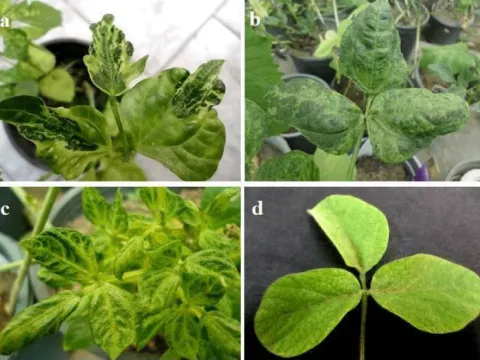
The main symptom of the disease is a characteristic mosaic pattern on the leaves, showing an alternation of light green and dark green patches. The spots can have irregular shapes, often accompanied by deformation of the leaf blade.
Plants infected with Gammacarmovirus vignae significantly lag in growth and development. Internodes become shortened, and the total mass of vegetative organs decreases noticeably compared to healthy plants.
In the later stages, chlorosis is observed, which can transition into necrotic processes. Leaf tissues lose turgor, become brittle, and fall off prematurely, exposing the stems.
Flowering becomes sparse or completely stops under severe infection. Flowers that manage to form often have an abnormal structure and are prone to shedding, leading to a sharp decline in yield.
Fruits also show signs of the disease: they become deformed, covered in spots or stripes, and lose their marketability and taste. The germination of seeds obtained from such plants is reduced.
Moderate air temperatures and high humidity promote the development of the virus. The favorable temperature range for active viral replication is between +20 and +28 degrees Celsius.
In greenhouses or high-density plantings, the virus spreads significantly faster due to the microclimate, which promotes the multiplication of insect vectors. A moist environment helps preserve viral particles on soil and tool surfaces.
The presence of weeds in the immediate vicinity of the crops creates reservoirs for the virus during the off-season. Many weed species within the legume family can be hidden carriers of the infection.
Agricultural factors, such as frequent sprinkler irrigation or high plant density, increase contact between individuals, which accelerates the mechanical spread of the pathogen during maintenance work.
Using uncertified seed material infected with the virus is the primary condition for the emergence of epiphytotics in new fields where the disease has not been previously recorded.
The economic damage from cowpea mosaic consists of critical yield losses, which can reach 50-80 percent depending on the stage of infection and environmental conditions.
In addition to quantitative losses, the quality of the beans suffers greatly. Deformed and small fruits do not meet market standards and become unsuitable for sale or long-term storage.
The virus weakens the plant's immune system, making it vulnerable to secondary fungal and bacterial infections. As a result, infected plantings often die from a complex of overlapping diseases.
The high contagiousness of the virus requires strict quarantine measures within the farm. Infected areas may become unsuitable for cultivating susceptible legume varieties for a long time.
The loss of seed stock is a long-term threat since the virus is seed-borne, which makes it impossible to use harvested crops for future sowing without expensive purification.
Prevention is the only effective control method. It is essential to use only healthy, verified seed material that has been certified as free from viral pathogens.
Strict spatial isolation between plantings of different years must be maintained. Weed control and the management of insect vectors (primarily aphids) are crucial components of crop protection.
- Disinfect garden tools after each use in sodium hypochlorite or alcohol solutions.
- Spatial isolation from perennial legume crops that can serve as an infection source.
- Timely removal and destruction of diseased specimens from the field (phytosanitary roguing).
The application of systemic insecticides helps limit the population of viral vectors, reducing the speed of disease spread across the field, though it does not cure already infected plants.
Breeding varieties resistant or tolerant to Gammacarmovirus vignae is the most promising and cost-effective method of protection in commercial vegetable production.