
Cotton leaf curl virus
Begomovirus gossypigeziraense
Description
Symptoms
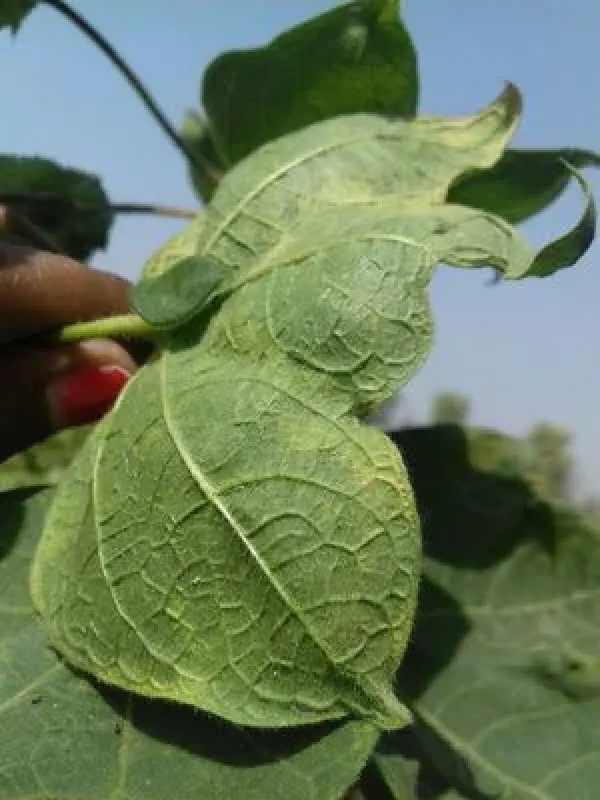
The hallmark symptom is the upward curling of leaves, which gives the plant a characteristic "curly" or stunted appearance.
Prominent thickening of the veins on the underside of leaves is commonly observed, often accompanied by the development of leaf-like outgrowths known as enations.
Infected plants show severe stunting, shortened internodes, and a reduced number of fruiting branches, significantly hindering overall plant architecture.
Flowering is adversely affected, leading to excessive bud shedding and the production of small, malformed bolls that fail to mature properly.
If the infection occurs at the seedling stage, the plants may collapse or stop growing entirely, leading to poor stand establishment.
Pathogen
The causative agent of the disease is the Cotton leaf curl virus (CLCuV), a member of the Begomovirus genus within the Geminiviridae family. It is a single-stranded DNA virus known for its high rate of genetic recombination.
In nature, the virus is transmitted in a semi-persistent manner by the whitefly Bemisia tabaci, which acts as the primary vector for the disease.
The virus infects the plant's vascular tissues, disrupting the transport of photosynthates and leading to systemic infection across all vegetative and reproductive organs.
The continuous evolution and emergence of new virus strains make the development of resistant cotton cultivars a complex and ongoing challenge for breeders.
Molecular diagnostic techniques, such as PCR and loop-mediated isothermal amplification (LAMP), are essential for early detection of viral DNA in infected plant tissue.
Conditions for development
The outbreak intensity is directly correlated with the population density of Bemisia tabaci, which thrives under warm and dry climatic conditions.
Dry weather patterns facilitate the rapid migration of whiteflies from alternative host plants and weed reservoirs to cotton fields.
Weed management is crucial because many common weed species act as symptomless reservoirs, harboring the virus throughout the off-season.
Late planting often exposes younger, more susceptible plants to peak populations of whiteflies, increasing the risk of early-season infection.
High nitrogen fertilization can sometimes promote excessive succulent growth, which is highly attractive to whiteflies and favors their rapid reproduction.
Why it matters
Cotton leaf curl virus is one of the most economically damaging diseases in cotton-growing regions, potentially causing total crop failure in susceptible varieties.
Beyond quantity, the quality of cotton fiber is severely degraded; it becomes brittle, shorter in length, and difficult to process in textile manufacturing.
The disease imposes heavy financial burdens on farmers due to the high costs of frequent insecticide applications required to control the vector.
The uncontrolled spread of the virus across large landscapes creates long-term challenges for cotton cultivation, often forcing shifts in agricultural practices.
Significant yield losses directly correlate to the timing of infection, with earlier infection stages resulting in the most devastating consequences for the harvest.
Protection
Integrated Pest Management (IPM) focusing on the control of the whitefly population through systemic insecticides remains the primary defense strategy.
Crop rotation and the implementation of host-free periods are essential cultural practices to break the life cycle of both the virus and its vector.
Strict sanitation measures, including the eradication of weeds that host the virus, help reduce the primary inoculum pressure in the field.
Developing and deploying genetically resistant or tolerant cotton cultivars is the most sustainable and effective long-term approach for managing this disease.
Maintaining spatial separation and ensuring that farmers in a region coordinate their planting schedules can help prevent the rapid regional spread of the virus.
Discussion
No discussions yet — be the first.