
Cotton leaf curl virus
Begomovirus gossypii
The causal agent of this disease is the Cotton leaf curl virus (CLCuV), which belongs to the genus Begomovirus within the Geminiviridae family. It is a single-stranded DNA virus often associated with satellite molecules that enhance its virulence.
What the section contains
Cotton leaf curl virus
This is a systemic viral disease that severely disrupts the vascular functioning and hormonal balance of the host plant, leading to significant growth abnormalities.
The virus persists in reservoir hosts, including various weeds and other malvaceous plants, which serve as sources of infection during the off-season for cotton.
The primary vector for transmission is the whitefly (Bemisia tabaci). These insects acquire the virus by feeding on infected plants and transmit it to healthy ones during subsequent feeding sessions.
The incubation period of the virus within the plant is relatively short, allowing for rapid secondary spread throughout the field if the vector population is not managed effectively.
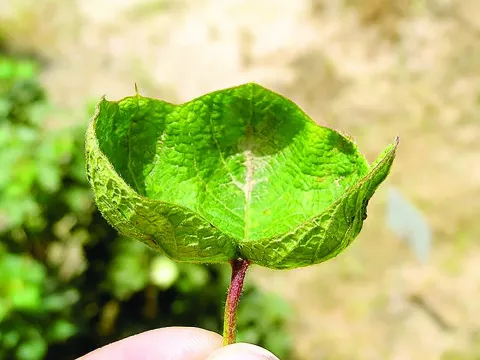
Characteristic symptoms include the upward or downward curling of leaf margins and the thickening of veins on the underside of the leaves, which often appear dark green.
A hallmark sign of the infection is the development of enations—leaf-like outgrowths—on the lower surface of the veins, which causes the leaves to twist and deform.
Infected plants show stunted growth with shortened internodes, giving them a bushy or rosetted appearance that is easily distinguishable from healthy plants.
Young leaves are typically wrinkled, leathery, and brittle. The overall canopy architecture becomes distorted as the plant fails to expand its foliage normally.
Flowering and boll formation are severely inhibited; many bolls may drop prematurely or fail to develop into mature, harvestable units.
The prevalence of the disease is heavily dependent on the population density of the whitefly vector, which thrives in warm and humid climates.
High temperatures and specific humidity levels accelerate the life cycle of the vector, leading to exponential increases in the transmission rate of the virus within cotton fields.
Poor agricultural practices, such as the failure to control weeds in adjacent fields or the use of susceptible varieties, facilitate the rapid expansion of the disease.
Changes in local weather patterns that favor vector migration are often followed by outbreaks of the disease as insects move across landscapes in search of host plants.
Optimal virus replication occurs at temperatures ranging between 25 and 32 degrees Celsius, which are standard for peak cotton growing seasons in tropical and subtropical regions.
Cotton leaf curl virus is highly destructive, capable of causing significant yield losses, sometimes ranging from 50 to 100 percent in severely affected and susceptible varieties.
The infection significantly degrades fiber quality, affecting its length, strength, and overall micronaire value, which reduces the market value of the harvested lint.
Plants affected by the virus exhibit weakened physiological defenses, making them more susceptible to secondary stressors, including other pests and fungal pathogens.
The economic burden is substantial, as growers must invest heavily in insecticide applications to curb whitefly populations, often with limited success during peak seasons.
Persistent infection leads to premature senescence of crops, which shortens the harvest window and reduces the final agricultural output per hectare.
The most robust management strategy involves the deployment of resistant or tolerant cotton cultivars, which remains the cornerstone of integrated pest management (IPM).
Rigorous sanitation measures, including the eradication of weed hosts around cotton fields, are critical to reducing the initial inoculum available to the whitefly vector.
- Strategic use of systemic insecticides to manage whitefly populations at early stages.
- Implementation of crop rotation patterns that discourage the buildup of vectors.
- Setting optimal sowing dates to minimize overlap with peak whitefly activity.
- Use of certified, virus-free seeds to ensure a clean start for the crop.
- Regular scouting for vectors and early signs of leaf curling to intervene promptly.
Effective management requires a coordinated approach across farming communities, as the virus can easily spread from one field to another through vector movement.
Biological control methods, such as encouraging natural enemies of whiteflies, can supplement chemical interventions to create a more sustainable and balanced control strategy.