
Cotton phyllody
Cotton small leaf agent
Description
Symptoms
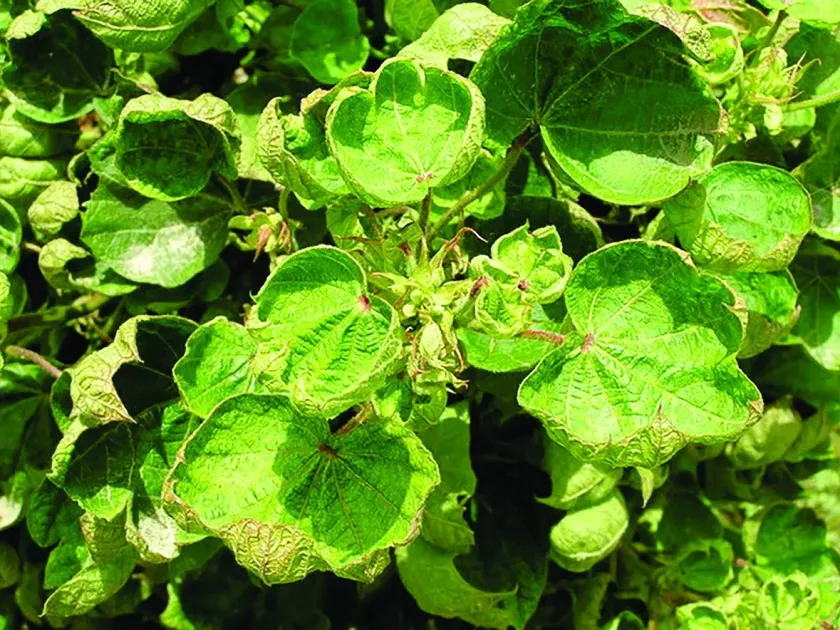
The hallmark symptom of cotton phyllody is the drastic reduction in leaf size, which gives the disease its name. Leaves often appear chlorotic, misshapen, and exhibit distorted margins compared to healthy foliage.
Infected plants display excessive branching and a "witches' broom" appearance, caused by the shortening of internodes. This leads to severe stunting, leaving the plant looking compact and underdeveloped.
Reproductive growth is severely hampered. Floral parts often fail to develop normally, resulting in sterile flowers or "leafy" structures instead of productive bolls. Any bolls that manage to form are often malformed and sterile.
Root systems are typically underdeveloped and weakened, reducing the plant’s ability to take up water and essential nutrients from the soil, further contributing to the general state of decline.
Symptoms typically manifest first on the upper vegetative parts of the plant and gradually spread downward, eventually affecting the entire structure of the cotton bush as the season progresses.
Pathogen
Cotton phyllody is a plant disease caused by phytoplasmas, which are specialized wall-less bacteria that inhabit the phloem tissue of infected plants. These pathogens are obligate parasites, meaning they cannot survive outside a living host.
The disease is transmitted by insect vectors, primarily leafhoppers. These insects acquire the phytoplasma while feeding on the phloem sap of infected plants and transmit the pathogen to healthy cotton plants during subsequent feeding sessions.
Once inside the host, the phytoplasma multiplies and spreads systemically throughout the plant. This interferes with the plant’s nutrient transport system, specifically affecting the movement of photosynthates and hormones.
The pathogen is known to persist in various perennial weed species during the off-season. These weeds serve as crucial reservoirs for the phytoplasma, ensuring its survival even when cotton is not being grown.
Research indicates that phytoplasmas responsible for phyllody can infect a wide range of botanical hosts, making the management of the surrounding ecosystem essential for controlling the disease in cotton fields.
Conditions for development
The spread of cotton phyllody is highly dependent on the population dynamics of its insect vectors. High leafhopper activity is a primary driver for the rapid escalation of the disease within fields.
Warm and moderately humid weather conditions provide an ideal environment for the rapid multiplication of leafhoppers. These climate patterns often coincide with peak infection periods in cotton-growing regions.
Proximity to weed-infested areas is a major risk factor. Weeds act as breeding grounds and hosts for both the insect vectors and the phytoplasma, creating a constant supply of infected pests.
Poor agricultural management, particularly the failure to clear field borders of weeds, creates a favorable habitat for the vectors, thereby facilitating the rapid transfer of the pathogen to the crop.
Continuous cotton cropping without proper crop rotation cycles maintains a high infectious pressure in the soil and local environment, allowing the pathogen to circulate easily year after year.
Why it matters
Cotton phyllody causes severe yield loss as infected plants become essentially barren. The disruption of reproductive processes means that the plant cannot produce viable lint, leading to massive harvest reductions.
The quality of any remaining fiber is severely compromised. It becomes shorter, weaker, and lacks the structural integrity required for high-quality industrial textile manufacturing, leading to lower market prices.
The disease causes premature senescence, meaning the plant ages and dies well before the end of the growing season. This prevents the plant from maximizing its photosynthetic potential.
Farmers face significant financial burdens due to the loss of crop value and the recurring costs associated with intensive insecticide applications intended to suppress insect vectors, which are often only partially effective.
In cases of high disease incidence, losses can reach up to 80 percent, which can lead to the total economic failure of a cotton field or the need to destroy entire segments of the crop.
Protection
The primary control measure is the proactive removal of weed reservoirs in and around the field to eliminate the habitat for both the pathogen and the insect vectors.
Timely application of systemic insecticides is necessary to suppress leafhopper populations. Treatments must be timed precisely with the life cycle of the vector to effectively reduce disease transmission.
Establishing spatial isolation between newly planted cotton fields and older, potentially infected areas can significantly reduce the migration of insect vectors, thereby slowing the spread of the disease.
Breeding and utilizing cotton cultivars with inherent resistance or tolerance to phytoplasma infections remains the most sustainable approach for managing the disease in the long term.
- Rigorous scouting for early disease symptoms.
- Rogueing or removing infected individual plants to reduce inoculum.
- Implementing crop rotation with non-host species.
- Monitoring insect populations using yellow sticky traps.
Discussion
No discussions yet — be the first.