
Cotton terminal disease
Cotton terminal
Cotton terminal disease is a complex plant condition often categorized as a physiological disorder or a systemic infection affecting the apical meristem.
What the section contains
Cotton terminal disease
In many regions, it is primarily associated with a severe deficiency of boron, an essential micronutrient for the development of new growth points.
Some forms of the disease are linked to phytoplasma infections transmitted by sucking insects such as aphids, leafhoppers, or whiteflies.
The disease can also manifest due to herbicide drift, causing terminal growth inhibition that mimics biological pathogen damage.
Understanding the specific cause is crucial, as the management strategies for nutrient deficiency differ significantly from those for insect-borne pathogens.
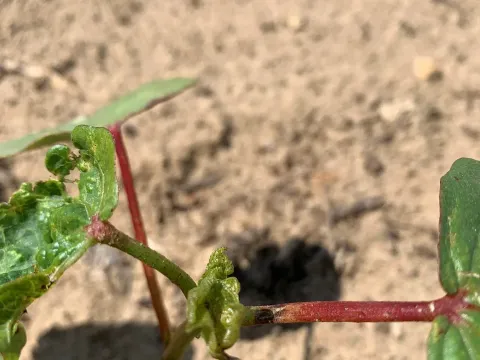
The hallmark sign of the disease is the sudden cessation of growth at the plant's terminal bud (the growing point of the main stem).
Affected leaves at the apex appear stunted, distorted, and often exhibit yellowing or reddening along the margins.
The plant loses its apical dominance, leading to excessive lateral branching, which creates a bushy, "witches' broom" appearance.
Internodes become significantly shortened, and the overall plant height is drastically reduced compared to healthy neighboring plants.
Flowering is severely restricted, and square (bud) shedding is frequently observed, preventing normal boll development.
The development of the disease is favored by fluctuating environmental conditions, particularly cycles of moisture stress and subsequent high humidity.
Alkaline soils with low boron availability are high-risk environments for the onset of this condition in cotton fields.
High population densities of insect vectors during the early vegetative stages significantly increase the incidence of phytoplasma-driven terminal disease.
Cultural practices that encourage rapid, succulent plant growth can increase susceptibility to both physical damage and pest colonization.
Late-season temperature spikes can exacerbate symptoms, causing rapid decline in fields that were previously only mildly symptomatic.
The economic impact is primarily driven by the reduction in total boll count per plant, as the primary fruiting site is compromised.
Fiber quality from affected plants is often degraded, leading to lower market value due to uneven maturity and reduced staple length.
Severe infestations can lead to significant yield losses, potentially rendering large portions of a field commercially non-viable.
The disease creates a persistent challenge for crop management, requiring intensive scouting and rapid response to prevent spread.
Resource loss is further compounded by the costs of emergency nutrient applications and repeated pest control treatments.
Foliar application of boron during critical growth stages is the most effective corrective measure for nutrient-related terminal stunting.
Proactive management of insect populations using integrated pest management (IPM) practices is essential to minimize vector-borne spread.
Effective weed management is vital to remove alternative hosts that harbor pathogens or insect vectors near the cotton crop.
Selecting and planting genetically resistant or tolerant cotton varieties serves as the foundation for long-term disease mitigation.
- Boron supplementation
- Vector population monitoring
- Resistant variety selection