
Sida golden mosaic
Begomovirus sidaureibrazilense
Sida golden mosaic is caused by a virus belonging to the genus Begomovirus, scientifically identified as Sida golden mosaic Brazil virus (Sidaureibrazilense). It is part of the Geminiviridae family, which is characterized by a circular single-stranded DNA genome.
What the section contains
Sida golden mosaic
The virus primarily infects members of the Malvaceae family, with species of the genus Sida being the main hosts. It displays narrow host specificity but can persist in weed reservoirs within the surrounding landscape.
The main vector for this virus is the tobacco whitefly (Bemisia tabaci). The transmission process is classified as circulative and persistent, meaning the virus survives and multiplies within the insect for a significant duration.
Upon feeding on an infected plant, the whitefly acquires the viral particles, which then migrate through the gut to the salivary glands. Once the vector becomes viruliferous, it can transmit the disease to healthy plants throughout its lifespan.
Inside the plant, the virus moves systemically via the phloem, eventually colonizing all parts of the host. Because of this systemic nature, once an infection is established, the entire plant remains a source of inoculum.
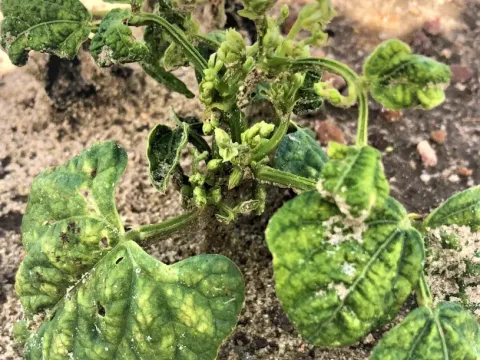
The hallmark symptom of this disease is a distinct yellow or golden mosaic pattern on the leaf blades. This pattern may appear as chlorotic spots, patches, or a complex net-like design following the leaf venation.
Early stages of infection often show chlorosis on younger leaves. As the disease progresses, the leaves become deformed, wrinkled, and may curl, which severely impacts the plant's ability to perform photosynthesis.
Infected plants exhibit stunted growth, which is a major indicator of the viral impact. Internodes become shortened, leading to a compact, bushy appearance that deviates significantly from the normal plant architecture.
Reproductive growth is also severely affected; flowers may abscise prematurely or fail to develop. Consequently, seed production and fruit formation are drastically reduced or entirely suppressed in infected specimens.
Visual diagnosis is often challenging due to symptom similarity with nutrient deficiencies. Therefore, molecular techniques like PCR are essential for confirming the presence of the Begomovirus in suspected samples.
The spread of Sida golden mosaic is highly dependent on whitefly population dynamics. Hot and dry weather conditions favor rapid multiplication of the insect vector and promote its active migration between fields.
Optimal temperatures for both the virus and the vector range from +25°C to +30°C. In such environments, the life cycle of the whitefly is significantly shortened, leading to explosive increases in insect density.
Weedy Malvaceae species act as essential reservoirs for the virus. These plants allow the virus to survive between crop cycles, providing a constant source of infection that facilitates the initiation of new outbreaks.
Poor agricultural practices, such as lack of spatial isolation between fields and failure to control weeds, contribute to a high infection pressure. Monocultures with high host density are particularly susceptible to rapid viral spread.
Inadequate sanitation and the use of infected planting material can also lead to the establishment of the disease in previously unaffected regions. Controlling the initial entry of the virus is paramount.
Sida golden mosaic causes significant economic damage to agricultural production by drastically reducing crop yields. Impaired photosynthesis due to leaf damage results in reduced biomass and poorer plant health.
For crops where the fiber or vegetative part is the primary product, the infection renders the harvest low-quality and commercially unusable. This forces farmers to face substantial losses at the market level.
Weakened plants are more susceptible to secondary infections by other pathogens, including fungi and bacteria. This cumulative stress often leads to the total loss of the crop before the intended harvest time.
The costs of managing the disease are substantial, involving both the loss of production and the expense of persistent chemical treatments against the vector. These inputs increase the overall production costs.
Environmental impacts also occur, as the presence of the virus can alter local biodiversity by affecting the distribution of sensitive plant species. It remains a serious challenge for sustainable agricultural development.
Effective management of Sida golden mosaic is primarily based on controlling the whitefly vector. The application of systemic insecticides is a standard practice to keep vector populations below the economic injury level.
Proactive prevention involves the removal of alternative weed hosts, especially those within the Malvaceae family, in and around the fields. This disrupts the viral life cycle and limits initial transmission.
Spatial isolation of crops from reservoirs and careful timing of planting can help reduce exposure to migrating whiteflies. Maintaining a clean field environment is crucial for reducing infection risks.
In greenhouse settings, physical barriers such as fine-mesh screens prevent whitefly ingress. Sticky yellow traps are used for monitoring purposes to trigger necessary control actions promptly.
- Systemic insecticide application for vector control
- Aggressive weed management in field surroundings
- Implementation of spatial isolation protocols
- Monitoring with yellow sticky traps
- Use of virus-indexed or resistant planting material