
Sida golden mosaic virus
Begomovirus sidaureibuckupense
The causal agent of this disease is the Begomovirus sidaureibuckupense, a member of the Geminiviridae family. This virus is characterized by a circular single-stranded DNA genome.
What the section contains
Sida golden mosaic virus
Like other begomoviruses, it relies on specific insect vectors to transmit the genetic material from one plant host to another, as it cannot be transmitted mechanically.
The primary vector responsible for the transmission of the virus is the whitefly species Bemisia tabaci, known globally for its efficiency in spreading plant viruses.
Once ingested by the whitefly during feeding on the plant phloem, the virus moves through the insect's body before being transmitted to the next host during a subsequent feeding event.
The rapid evolution of these viruses and the high adaptability of the insect vectors make this disease a challenging concern for agricultural security.
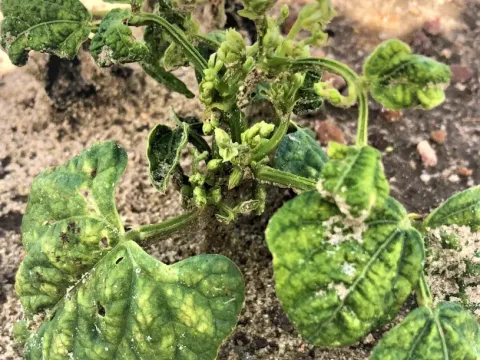
The disease manifests with striking visual symptoms, particularly a vivid golden or yellow mosaic pattern that gives the virus its name.
These chlorotic patterns are the result of interference with chlorophyll production and distribution within the leaf cells as the plant undergoes stress.
Typical symptoms observed on infected plants include:
- Interveinal chlorosis and yellowing
- Leaf curling and distorted edges
- Reduced leaf size (stunting)
- Interrupted floral development
- Overall thinning of the canopy
When examined in the field, plants display a marked heterogeneity in leaf color, often showing a mix of bright yellow patches and normal green tissue.
Advanced stages of the infection usually lead to significant dwarfing, where the plant stops developing normally and produces little to no harvestable yield.
Environmental conditions play a critical role in the epidemiology of the Sida golden mosaic virus by dictating the population dynamics of the whitefly vector.
Warmer temperatures significantly accelerate the life cycle of Bemisia tabaci, leading to rapid population growth and more frequent feeding cycles on crops.
Humid conditions or dense vegetation provide micro-environments that allow the vector to thrive, increasing the probability of widespread transmission within a field.
Reservoir hosts, such as wild Malvaceous plants growing near farmland, act as essential refuges for the virus during periods when primary crops are not available.
Increased human-mediated activity and migration of the insect vector between patches of vegetation are the primary drivers of the virus's seasonal spread.
The economic impact of the virus is significant, as it systemic infection disrupts the metabolic pathways essential for plant vitality and productivity.
The reduction in photosynthetic efficiency leads to stunted growth, resulting in lower biomass production and a decrease in the overall yield per hectare.
For commercial crops, the loss is compounded by the poor quality of fibers or fruits produced by infected plants, which often do not meet market standards.
Early-season infections are particularly destructive, often rendering the crop non-viable and forcing farmers to perform costly replanting procedures.
Furthermore, the cost of continuous insecticide applications needed to manage the whitefly vector adds a substantial burden to the operational budget of the farm.
Effective management requires an integrated approach that focuses primarily on breaking the transmission cycle by suppressing the whitefly population.
Implementing a strict spray schedule using insecticides with different modes of action is vital to prevent the development of resistance in whitefly populations.
Cultural practices, such as roguing infected plants and removing weeds that host the virus or the vector, are essential for maintaining field health.
Spatial isolation of planting sites and the use of physical barriers like fine mesh screens can significantly reduce the influx of whiteflies into sensitive crops.
Future sustainability in managing this disease lies in the development and adoption of resistant varieties that can limit the virus's replication and spread.