
Sida golden mosaic begomovirus
Begomovirus sidaureivenae
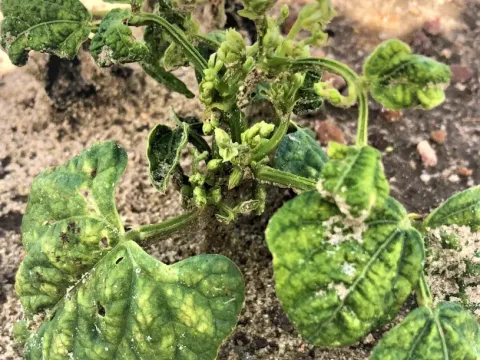
The primary symptom of infection is a distinct yellowing of the leaf tissue along the veins, which gradually spreads across the entire leaf blade.
What the section contains
Sida golden mosaic begomovirus
Infected plants typically exhibit severe leaf distortion, including curling, crinkling, or puckering, which significantly impairs photosynthetic efficiency.
Development is notably stunted, with shortened internodes resulting in a dwarf or suppressed appearance compared to healthy plant specimens.
A mosaic pattern is frequently observed, where bright yellow patches alternate with normal green tissue, creating a characteristic network-like appearance.
Over time, the overall reproductive capacity decreases, leading to a significant reduction in the quantity and quality of fruits or seeds produced.
The disease is caused by Begomovirus sidaureivenae, a virus belonging to the Geminiviridae family characterized by a single-stranded circular DNA genome.
This virus acts as an obligate parasite, entirely relying on the metabolic processes of the host plant cell for its replication and protein synthesis.
The whitefly Bemisia tabaci serves as the primary vector, acquiring the virus through phloem feeding on an infected plant host.
Following acquisition, the virus undergoes persistent circulation within the vector, allowing the whitefly to transmit the pathogen throughout its lifespan.
The virus predominantly affects plants within the Malvaceae family, particularly species of the genus Sida, which act as natural reservoirs.
The spread of the virus is closely linked to the population dynamics of the whitefly vector, with outbreaks peaking during hot and dry weather conditions.
Optimal temperatures ranging between 25 and 30 degrees Celsius facilitate rapid whitefly reproduction and accelerate the transmission cycle between plants.
The presence of wild host weeds near crop fields provides an ideal environment for the virus to persist during off-seasons and spread early in the year.
Insufficient spatial isolation between infected wild populations and cultivated crops significantly increases the risk of wide-scale epidemics.
Wind-driven migration of whiteflies, combined with human activity during cultivation, can transport the pathogen over considerable distances.
Sida golden mosaic begomovirus causes significant economic losses by drastically reducing crop yields and degrading the commercial quality of the harvest.
Infection during the early vegetative stage leads to severe growth inhibition, often resulting in total crop failure or a complete lack of marketable produce.
Reduced photosynthetic activity weakens the plant's natural immune response, making it highly susceptible to secondary fungal and bacterial infections.
Metabolic disruption negatively alters the biochemical profile of the plant, potentially affecting the nutritional value and flavor of harvested fruits.
Since there are no curative treatments for infected plants, management requires the removal and destruction of diseased specimens, increasing operational costs.
The primary control measure involves rigorous phytosanitary practices, including the prompt removal and destruction of infected plants to limit spread.
Effective management of the whitefly population using systemic insecticides is critical to interrupting the virus transmission cycle.
Adopting agronomic practices such as crop rotation and weed control, especially targeting Malvaceae species, helps reduce the reservoir of infection.
The selection and use of virus-resistant or tolerant crop varieties remain the most sustainable and cost-effective approach for long-term management.
- Regular monitoring of crop fields for whitefly infestations.
- Utilization of yellow sticky traps to estimate vector pressure.
- Implementation of insect-proof netting in greenhouse environments.
- Maintaining optimal irrigation to support plant vigor and health.