
Sida golden mosaic virus
Begomovirus sidaureifloridaense
The causal agent is the Begomovirus sidaureifloridaense, a member of the Geminiviridae family. This virus possesses a single-stranded circular DNA genome and is a specialized plant pathogen.
What the section contains
Sida golden mosaic virus
The pathogen relies heavily on its insect vector, the whitefly Bemisia tabaci, for transmission and dissemination within agroecosystems.
It maintains its cycle by residing in various weeds, particularly those within the Malvaceae family, which act as primary viral reservoirs during the off-season.
The virus exhibits persistent transmission, meaning once the whitefly acquires the virus, it remains infectious for the remainder of its life cycle.
Due to its genomic stability and ability to hijack host cellular machinery, the virus effectively suppresses plant defenses, leading to chronic systemic infection.
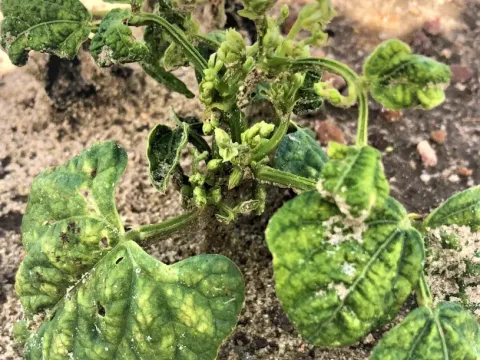
Symptoms are characterized by a distinctive golden-yellow mosaic pattern on the leaves, which gives the disease its common name.
Infected plants display significant stunted growth, with shortened internodes and a bushy appearance that deviates significantly from healthy counterparts.
Leaves often show severe curling, distortion, and yellowing, which restricts the plant's ability to undergo effective photosynthesis.
In advanced stages of infection, plants may experience leaf necrosis and premature shedding, leading to a drastic reduction in biomass.
Reproductive success is severely compromised, with reduced flowering and fruit set, often rendering the crop economically worthless.
Viral development is intrinsically linked to the population dynamics of the whitefly vector, which thrives in hot and dry climates.
High temperatures accelerate the reproductive rate of Bemisia tabaci, leading to rapid colonization of new host plants during the summer months.
The presence of wild Sida species in proximity to cultivated fields provides a constant source of inoculum for the primary infestation.
Agricultural mismanagement, such as poor weed control and excessive nitrogen fertilization, can exacerbate the impact of the viral spread.
The most critical window for infection occurs during the seedling stage, where even a small number of viruliferous whiteflies can cause widespread damage.
The primary economic impact is the severe loss of yield, caused by systemic debilitation of the crop and reduced fruit quality.
The disease affects the physiological health of the plant, making it more susceptible to secondary fungal and bacterial opportunistic infections.
High management costs are associated with the need for intensive insecticide applications to control the whitefly populations across large areas.
There is a risk of significant economic loss in regions where Malvaceae crops are major agricultural commodities, as entire fields can be devastated.
The virus represents a long-term threat to regional biosecurity due to its wide host range among weeds and cultivated crops.
Management focuses on vector control and the removal of infection sources to prevent the initial introduction of the virus into the field.
Rigorous weed control, particularly targeting Sida species, is essential to minimize the inoculum pressure around the plantation.
The use of virus-free planting material and resistant cultivars is the most sustainable approach to long-term crop protection.
Exclusion methods, such as utilizing insect-proof netting in greenhouses and nurseries, effectively block whitefly access to vulnerable plants.
- Deployment of yellow sticky traps to monitor whitefly population density.
- Judicious use of systemic insecticides to manage vector outbreaks.
- Strategic planting times to avoid peak activity periods of the insect vector.