
Sida golden mosaic virus
Begomovirus sidaureimaculae
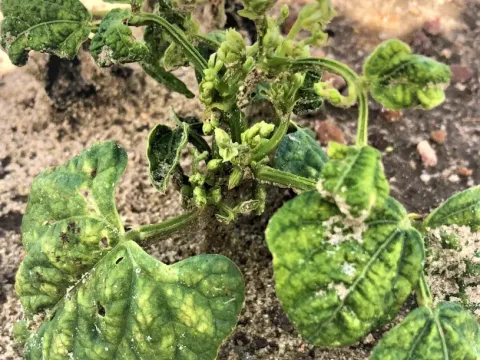
The primary symptom of this disease is a distinct golden-yellow mosaic pattern or chlorotic spotting on the leaves. Infected plants often show characteristic leaf curling and distortion.
What the section contains
Sida golden mosaic virus
Growth reduction is highly visible, with the plant appearing stunted and abnormally bushy due to shortened internodes. The overall canopy density decreases as the infection progresses.
Flowering and seed production are significantly affected, often resulting in complete yield failure in highly susceptible varieties of Sida.
In early stages, the disease may manifest as mild interveinal yellowing, which eventually evolves into severe chlorosis and leaf necrosis under stress conditions.
Visual symptoms can vary depending on the plant variety and environmental stressors, sometimes mimicking nutritional deficiencies, which makes field diagnosis challenging.
The causal agent is Begomovirus sidaureimaculae, a virus with a single-stranded DNA genome belonging to the Geminiviridae family. These viruses are characterized by their twin-particle morphology.
The virus is transmitted by the whitefly Bemisia tabaci in a circulative, non-propagative manner. The virus must be acquired by the insect from an infected source to become transmissible.
Once inside the plant, the virus replicates within the nucleus of the host cells, disrupting normal metabolic pathways and protein synthesis essential for plant development.
The genetic diversity of these begomoviruses allows them to adapt to different host plants and vector populations, presenting a continuous challenge for plant pathologists.
Molecular detection via PCR is the gold standard for identifying Begomovirus sidaureimaculae, ensuring differentiation from other co-infecting viruses.
The whitefly Bemisia tabaci is the essential vector for the virus. Outbreaks of the disease are directly correlated with whitefly population surges in the field.
Warm temperatures, high humidity, and stable weather conditions provide an optimal environment for the proliferation of the vector, leading to rapid disease spread.
Weeds within the Malvaceae family act as primary reservoirs, harboring the virus throughout the year and serving as an inoculum source for new seasonal crops.
Cultivation practices, such as monocropping and high-density planting, can facilitate the movement of vectors and increase the incidence of mosaic outbreaks.
Agricultural areas located near wild habitats with known host weeds are at higher risk of experiencing primary infection events early in the growing season.
The virus causes severe damage to crops by crippling the photosynthetic efficiency of the plant, which leads to a dramatic reduction in biomass and yield.
Plants affected by Begomovirus sidaureimaculae show poor stress tolerance, making them susceptible to secondary pests and various environmental stressors.
Economic losses arise not only from reduced crop quality but also from the increased financial burden of applying frequent insecticides to control the insect vector.
The disease can cause total loss in small-scale plantings if the infection occurs during the early vegetative stage, preventing normal structural development of the plant.
Systemic infections cause permanent damage, meaning there is no recovery for symptomatic plants, which necessitates their immediate removal to protect neighboring crops.
Management focuses primarily on integrated pest management (IPM) to control the whitefly population, including the use of systemic insecticides and physical barriers.
Sanitation is critical; removing infected plants and eradicating reservoir weeds helps break the disease cycle and lowers the initial inoculum in the area.
Developing and planting resistant cultivars remains the most sustainable approach to managing the spread of Sida golden mosaic virus in agricultural landscapes.
Regular monitoring using yellow sticky traps is recommended to track whitefly density and determine the appropriate timing for protective interventions.
- Implement crop rotation to disrupt the whitefly host cycle.
- Use reflective mulches to deter vectors from landing on crops.
- Apply biological controls, such as parasitoid wasps or entomopathogenic fungi.
- Ensure spatial isolation between susceptible plantations.