
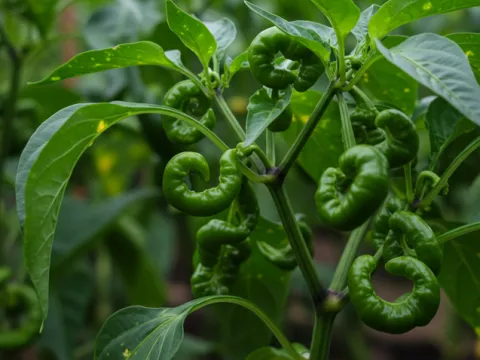
Pepper leaf curl virus
Begomovirus capsiahmedbadense
The causal agent is Begomovirus capsiahmedbadense, a member of the Geminiviridae family. These viruses are characterized by bipartite or monopartite circular single-stranded DNA genomes encapsidated in twinned particles.
What the section contains
Pepper leaf curl virus
This virus is transmitted in a persistent circulative manner by the whitefly Bemisia tabaci. Once the insect acquires the virus during feeding, it remains infectious for the remainder of its life span.
The virus infects the plant's phloem tissues. Following inoculation, the virus moves systemically throughout the plant, interfering with nutrient translocation and normal physiological processes.
Host range is primarily restricted to members of the Solanaceae family, including peppers, tomatoes, and certain weeds that act as perennial reservoirs for the virus.
Environmental stability of the virus is high within the host tissues, allowing it to persist throughout the growing season and survive in alternative hosts during adverse weather conditions.
The most distinctive symptoms are severe leaf curling, puckering, and inward or outward distortion of the leaf margins, giving the foliage a stunted and crinkled appearance.
Yellowing (chlorosis) frequently occurs, typically appearing as a mosaic pattern or interveinal yellowing. In many cases, the leaf lamina becomes thickened and leathery to the touch.
Infected plants exhibit severe stunting with significantly shortened internodes, creating a bushy, stunted growth habit that is easily recognizable in field conditions.
Reproductive success is severely impacted, with flower abortion being common. If fruit sets, it is often small, distorted, and may exhibit discolored patches, rendering it unmarketable.
Presence of high populations of whiteflies on the abaxial (lower) leaf surface is a frequent indicator that virus transmission may be actively occurring in the crop canopy.
The economic impact of this virus is substantial, often resulting in total crop failure if infection occurs during the early seedling stage. Yield loss is primarily due to the lack of marketable fruit.
Since the virus causes systemic changes, the entire plant is compromised, leading to reduced photosynthetic efficiency and early senescence of the foliage.
The spread of the disease is rapid in areas with high whitefly pressure, making it difficult to contain without rigorous management of the insect vector population.
Plants affected by the virus are more susceptible to secondary biotic stressors, including opportunistic fungal and bacterial infections that target weakened tissue.
Farmers often experience severe financial losses because the virus can render an entire field of peppers unfit for sale, regardless of the quality of the agricultural practices used.
Integrated Pest Management (IPM) is essential for control, primarily focusing on the suppression of the whitefly population through timely application of systemic insecticides.
Cultural practices, such as the use of fine-mesh exclusion netting for greenhouse production, can effectively prevent whitefly entry and subsequent virus inoculation.
Eliminating weed reservoirs around the field perimeter is a critical step in reducing the local inoculum pressure and breaking the virus transmission cycle.
Using yellow sticky traps provides an early warning system to monitor whitefly activity, allowing for preemptive insecticide treatments before the pest population peaks.
Prompt roguing and destruction of symptomatic plants is necessary to reduce the source of viral inoculum, preventing the spread to healthy neighboring plants in the field.