
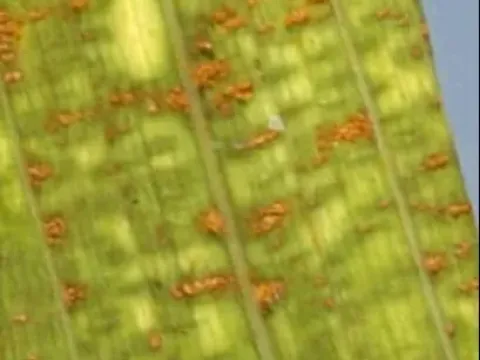
Watsonia rust
Uromyces watsoniae
The causative agent of this disease is a highly specialized pathogenic fungus from the order Pucciniales, known as Uromyces watsoniae. It is an obligate parasite, meaning it relies entirely on the tissues of a living host plant for its life cycle.
What the section contains
Watsonia rust
This fungus primarily infects species within the Iridaceae family, with Watsonia being the main host. The pathogen reproduces through spores, which are disseminated by wind, rain splashes, or insects, leading to rapid infection across garden beds.
The life cycle of the pathogen involves various spore stages, which enable it to survive the winter in plant debris or on dormant bulbs. In suitable climatic conditions, the fungus can maintain its viability in the soil for several years.
Biologically, Uromyces watsoniae penetrates the leaf tissue by entering the intercellular spaces. As the mycelium grows, it forms pustules that rupture the plant's epidermis, releasing masses of spores into the surrounding environment.
The disease typically becomes active in the spring when temperatures consistently reach 12–15°C. High plant density and limited air movement provide optimal conditions for the fungus to jump from infected individuals to healthy ones.
The first visual signs of infection are small, pale, or yellowish spots appearing on the leaves. Over time, these spots develop into raised, rusty-brown pustules, which are characteristic of rust diseases.
As the infection progresses, these pustules can merge into long streaks or cover large areas of the leaf surface, causing the leaves to yellow prematurely and eventually shrivel and die.
On the undersides of the leaves, a powdery reddish-brown mass of spores is often visible. This mass can be easily rubbed off, indicating the active sporulation stage of the fungus, which serves as a major source of secondary infection.
Stems and flower stalks may also show elongated pustules. The infection typically moves from the lower foliage upwards, which is a common pattern for rust diseases affecting various bulbous plants.
If left unmanaged, the entire foliage can become severely blighted, leading to a significant loss of aesthetic appeal. The plant's ability to undergo photosynthesis is severely compromised, putting its health at risk.
The primary factor for the development of Watsonia rust is high relative humidity, particularly above 75–80%. Dew or lingering moisture from rainfall on the foliage provides the ideal environment for spore germination.
The fungus thrives in warm temperatures, ideally between 18°C and 24°C. Under these conditions, the incubation period is shortened significantly, allowing for rapid disease spread and severe outbreaks in a short timeframe.
Poor airflow, often caused by overcrowding or thick weed cover, traps moisture around the base of the plant. This creates a localized microclimate that is perfectly suited for fungal colonization and infection.
Excessive application of nitrogen-based fertilizers results in soft, succulent leaf tissue that is much easier for the fungal mycelium to penetrate. A balanced nutrient regimen is essential to maintain plant tissue toughness.
Failing to rotate crops and planting Watsonia in the same location year after year leads to an accumulation of inoculum in the soil, which significantly increases the pressure of the disease on new plantings.
The main damage caused by Watsonia rust is a sharp decline in photosynthetic activity. Because the leaf surface is covered in pustules, the plant cannot produce enough energy to sustain healthy growth.
The rupture of the epidermis compromises the plant's water-holding capacity, leading to excessive transpiration. This causes the plant to wilt rapidly and eventually desiccate, especially during hot, dry periods.
Chronic rust infection severely depletes the energy reserves stored in the bulbs. This leads to stunted growth, reduced flower production, and, in severe cases, the eventual death of the bulb during dormancy.
For commercial growers, Watsonia rust significantly impacts the quality and marketability of planting material. Infected stock often fails to meet professional standards and may need to be discarded.
Furthermore, weakened plants are much more susceptible to secondary pathogens, such as bulb rots, which can take hold during storage and cause total loss of the planting material over the winter.
The most important preventive measure is good horticultural practice: regular weeding, adequate spacing between plants to improve airflow, and keeping the planting area free of debris to lower humidity.
Fungicide application is the most effective control method once the disease is detected. Systemic treatments based on triazoles or strobilurins are effective at halting the spread of Uromyces watsoniae if applied promptly.
Sanitation is critical; all infected plant material must be removed and destroyed by burning or deep burial at the end of the season. This significantly reduces the amount of overwintering inoculum in the garden.
When purchasing new stock, growers should carefully inspect bulbs for any signs of rot or fungal growth. Only healthy, clean, and firm bulbs should be planted to avoid introducing the disease to the site.
In cases of severe outbreaks, repeated fungicide applications at 10–14 day intervals are recommended. Rotating different chemical classes of fungicides is essential to prevent the fungus from developing resistance.