
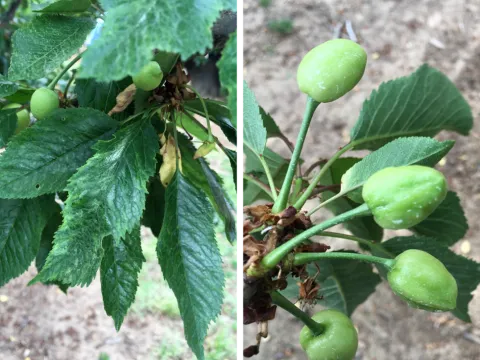
Western X-disease
Western spp.
Western X-disease is a serious plant disease caused by the phytoplasma Candidatus Phytoplasma pruni, which colonizes the phloem tissue of the host plant.
What the section contains
Western X-disease
This pathogen disrupts the movement of photosynthates and nutrients throughout the tree, leading to a decline in physiological health and vitality.
As a systemic pathogen, it resides within the plant's vascular system, making it impossible to cure an infected tree using conventional chemical sprays.
The phytoplasma is an obligate parasite, relying entirely on its host or insect vectors for survival and reproduction within the plant tissue.
Transmission occurs exclusively via insect vectors, primarily leafhoppers, which acquire the pathogen while feeding on infected plant sap.
Infected almond trees typically display early foliar symptoms such as chlorosis and the development of reddish-purple leaf discoloration during the summer months.
Leaves often become deformed, curl upwards, and drop prematurely, starting from the lower parts of the branches and progressing upwards.
Fruit development is significantly impaired; the fruit remains small, misshapen, lacks flavor, and often falls from the tree long before reaching maturity.
A diagnostic characteristic of Western X-disease is the uneven appearance of the canopy, where some branches may appear healthy while others show clear signs of decline.
Over time, terminal buds fail to develop, the tree exhibits dieback, and general vigor declines until the tree eventually dies or becomes unproductive.
The disease is primarily spread by several species of leafhoppers (such as Colladonus montanus), which act as efficient vectors for the phytoplasma.
These insects acquire the infection by feeding on wild hosts or weeds surrounding the orchard, then transmit it to healthy commercial trees.
Warm and dry weather conditions generally increase insect activity, facilitating the rapid spread of the pathogen throughout the planting site.
Orchards located near brushy areas or abandoned fields are at a higher risk of infestation due to the proximity of natural reservoirs for the insect vectors.
High plant density and inadequate weed management provide favorable microclimates for leafhopper breeding, increasing the infection pressure.
Western X-disease causes significant economic losses, as it renders infected trees unproductive and diminishes the quality of the harvested crop.
Fruit from infected almond trees is often non-marketable, leading to decreased yields and financial instability for the grower.
The disease weakens the tree's overall immune system, making it more susceptible to secondary attacks by wood-boring insects and environmental stress.
The irreversible nature of the infection frequently necessitates the removal and destruction of entire trees to prevent further spread within the orchard.
Replanting costs and the time required for new trees to reach maturity place a heavy financial burden on agricultural producers affected by this pathogen.
The most crucial control measure involves the systematic identification and immediate removal of infected trees to eliminate the source of the pathogen.
Implementing a rigorous insect management program using targeted insecticides is essential to keep the population of leafhoppers below the economic threshold.
Orchard sanitation, including the removal of weeds and wild host plants in and around the orchard, is vital for reducing vector populations.
Growers should strictly use certified nursery stock that has been screened and tested to be free from phytoplasma infections prior to planting.
Monitoring for insect vectors using yellow sticky traps helps in timing insecticide applications effectively and preventing the spread of the disease.