
Wheat stripe rust
Puccinia striiformis
Description
Symptoms
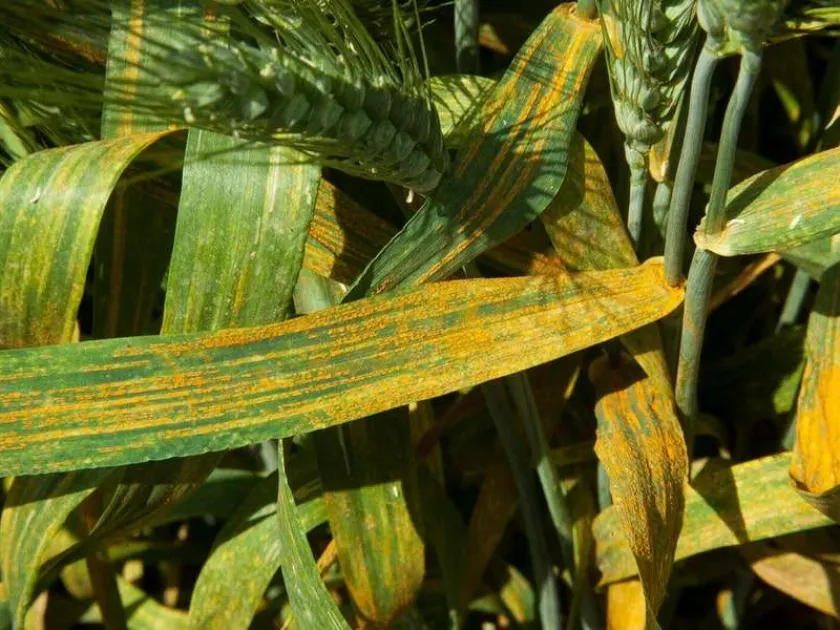
The most distinctive symptom is the appearance of bright yellow pustules (uredinia) on leaves, leaf sheaths, and spikes. They are arranged in long, narrow rows between the leaf veins, giving the disease its common name, stripe rust.
Under severe infection, pustules can coalesce to form dense stripes covering the entire leaf surface. This causes rapid depletion of nutrients and a significant reduction in the plant's photosynthetic capacity.
In the final stages of the life cycle, the fungus produces telia, which appear as black, shiny pads covered by the epidermis, containing teliospores. This stage signals the end of the pathogen's active vegetative growth.
Visually, affected fields may display patches of yellowing, which is particularly evident in susceptible wheat cultivars. In cases of mass infection, the entire crop can appear chlorotic and stunted.
- Bright yellow pustules organized in stripes.
- Leaf damage and epidermal rupture.
- Spike discoloration and grain shriveling.
- Black telia formation in late stages.
- Stunted plant growth and premature senescence.
Pathogen
The causative agent of the disease is an obligate parasite, the basidiomycete fungus Puccinia striiformis f. sp. tritici. This pathogen is highly specialized and primarily affects wheat, along with certain barley varieties and wild grasses.
The fungus has a complex life cycle, but in epidemic conditions, it propagates asexually by producing urediniospores. These spores are highly mobile and can be carried by wind currents over long distances to infect new fields.
The mycelium develops intercellularly within the host tissue, entering through leaf stomata. As the fungus colonizes the plant, it creates characteristic pustules that rupture the epidermal layer of the leaves, stems, and sometimes spikes.
The pathogen primarily overwinters as mycelium in winter wheat tissues or volunteer cereals in regions with mild winters. In spring, when conditions become favorable, mass sporulation occurs.
The presence of a "green bridge" (volunteer plants or early-sown winter crops) is a critical factor for the survival and rapid spread of the inoculum from one season to the next.
Conditions for development
Stripe rust development is highly dependent on cool to moderate temperatures. The optimal range for spore germination and infection is between +10°C and +15°C.
High relative humidity, dew, or light rain are essential conditions that provide the surface moisture required for spores to germinate and penetrate the host plant's tissues.
Infection rates often peak in the spring after a mild winter, as the cool and moist environment favors the rapid spread of the fungus on young, developing wheat leaves.
Extended periods of hot, dry weather (temperatures consistently above +20...+25°C) inhibit the growth of Puccinia striiformis, as the pathogen is sensitive to thermal stress and desiccation.
Wind is the primary vector for spore dispersal, allowing the disease to move rapidly across large agricultural landscapes within a very short period.
Why it matters
The economic impact of wheat stripe rust is significant, primarily due to the severe loss of green leaf area, which hinders grain filling and overall biomass accumulation.
When the flag leaf is heavily infected, yield losses can reach 30–50% or more. The resulting grain is typically shriveled, with a low thousand-kernel weight and poor processing quality.
Early-season infections can reduce winter survival of crops, leaving the plants weaker and more susceptible to environmental stress during the dormant period.
Infection of the wheat head can lead to blank florets or poor kernel development, drastically reducing the total volume of harvestable produce per hectare.
Epidemic outbreaks of stripe rust are a major threat to food security, often requiring expensive and timely chemical interventions to prevent total crop loss.
Protection
The most effective strategy for managing stripe rust is the cultivation of genetically resistant wheat varieties that can withstand local races of the pathogen.
Cultural practices include crop rotation, the destruction of volunteer wheat plants, and the removal of weeds that act as potential reservoirs for the fungal spores.
Balanced fertilization, particularly adequate phosphorus and potassium levels, helps improve the plant's natural defense mechanisms against fungal diseases.
Chemical control involves the timely application of systemic fungicides from the triazole or strobilurin groups at the first sign of symptoms to halt disease spread.
Regular field scouting starting from the booting stage is essential to monitor infection levels and ensure that fungicide applications are conducted within the optimal window for efficacy.
Discussion
No discussions yet — be the first.