
Potato rhizoctonia
Potato rhizoctoniosis
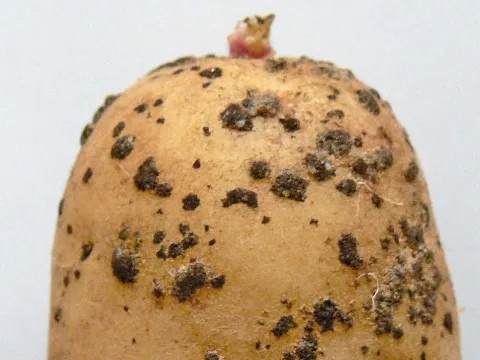
Symptoms of rhizoctonia, often referred to as black scurf, appear as dark brown or black sclerotia on the surface of potato tubers, resembling soil particles.
What the section contains
Potato rhizoctonia
In young plants, the fungus causes stem canker, where necrotic lesions appear on underground stems, often leading to stunted growth or complete plant death.
During humid conditions, a characteristic white, felt-like mycelium may develop on the stems near the soil line, known as the white cuff stage.
Infected plants frequently exhibit upward leaf rolling and chlorosis, while aerial tubers may form in leaf axils due to restricted nutrient translocation.
The root system is often compromised, showing signs of browning and rotting, which prevents the plant from absorbing necessary water and nutrients effectively.
The disease is caused by the soil-borne fungus Rhizoctonia solani, which exists primarily in the form of sclerotia within the soil and on tuber surfaces.
It is a highly versatile pathogen with a broad host range, allowing it to survive on various weed species and crop debris in the absence of potatoes.
The fungus propagates through vegetative mycelial growth, which can travel through the soil to reach emerging sprouts and developing root systems.
It possesses the ability to survive in a saprophytic state for long periods, utilizing organic matter when living host plants are not available.
The complex life cycle of the pathogen makes it extremely difficult to eradicate once it has become established in a particular field environment.
Development is heavily favored by cool and damp soil conditions, especially during the crucial period of initial potato sprout emergence.
Delayed emergence due to cold temperatures allows the fungus more time to penetrate the delicate tissues of the plant before it breaks the soil surface.
Soil compaction and poor drainage exacerbate the infection, as the fungus thrives in environments with limited oxygen exchange in the root zone.
High moisture levels in the canopy during the late season promote the development of the sexual stage and further sporulation of the pathogen.
Frequent cropping of potatoes on the same site without proper rotation leads to a significant increase in the inoculum potential within the soil.
The primary economic impact is the reduction of plant stand uniformity, which significantly lowers the overall yield potential of the field.
Tuber quality is severely degraded, as the presence of sclerotia and malformations makes the harvest unattractive for the fresh market or processing.
The reduction in stolon development leads to fewer and smaller tubers, directly decreasing the weight of the harvest per unit of area.
The disease contributes to the buildup of inoculum, effectively contaminating the soil and making future potato production more costly and difficult.
Severe infestations can result in yield losses of up to 30 percent, posing a major threat to the financial viability of potato farming operations.
The most important control measure is the use of high-quality, certified, disease-free seed tubers to prevent the introduction of the fungus.
Applying effective chemical seed treatments or in-furrow fungicides at planting is a proven method to protect sprouts from soil-borne inoculum.
Implementing a diverse crop rotation strategy, avoiding potatoes after other solanaceous crops, helps reduce the pressure of the pathogen in the soil.
Ensuring adequate soil preparation and timing planting when soil temperatures are warm encourages rapid emergence and early plant vigor.
- Maintaining balanced soil fertility levels to avoid excess nitrogen.
- Prompt removal and destruction of infected crop residues after harvest.
- Improving soil aeration through proper cultivation techniques.