

Disease
Especially harmful
Rhynchosporium leaf scald
Rhynchosporium spp.
Description
Symptoms
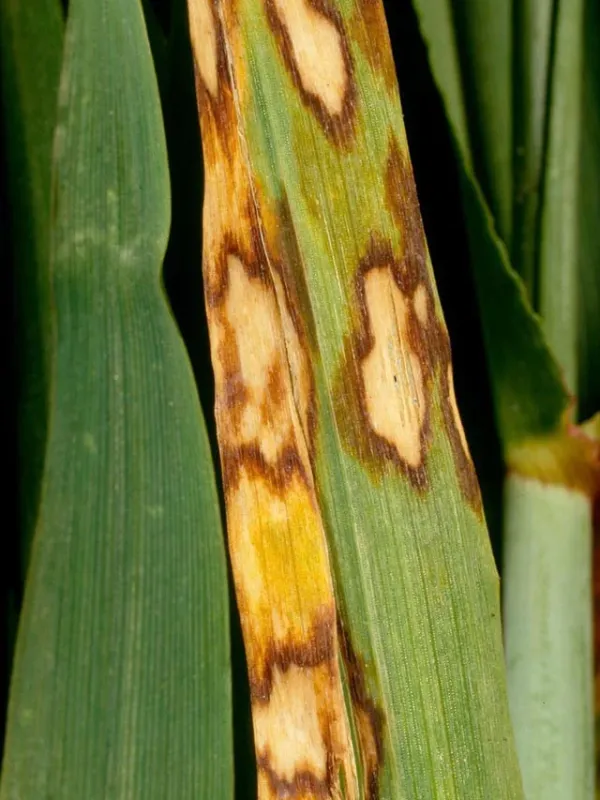
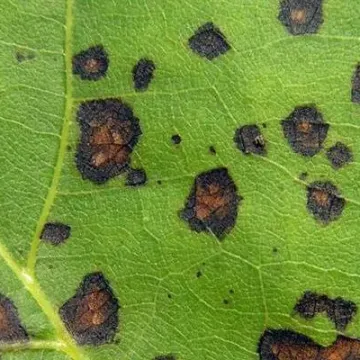
The diagnostic symptom is the presence of characteristic lesions often described as "scalds." Initially, these appear as blue-green or grey-green blotches.
As the lesion matures, the center turns light grey or white, surrounded by a distinct dark brown border, giving it a typical eye-shaped or diamond-like appearance.
Under severe infection, lesions coalesce, leading to extensive chlorosis and necrosis of the entire leaf, eventually causing the leaf to wither and die prematurely.
During periods of high humidity, a greyish mat of conidia may become visible on the surface of the lesions, indicating active spore production.
The disease usually progresses from the lower canopy to the upper leaves, significantly impacting the photosynthetic capacity of the plant during the critical grain-filling period.
Pathogen
The disease is caused by fungal pathogens from the genus Rhynchosporium, with Rhynchosporium secalis being the most prevalent species affecting barley and rye.
The pathogen survives as mycelium on crop debris, volunteer plants, and infected seeds, serving as the primary inoculum for the new growing season.
During the growing cycle, the fungus spreads via conidia, which are splashed by rain or wind-blown onto healthy foliage to initiate secondary infections.
The fungus is highly adapted to temperate climates and requires specific conditions of humidity to successfully germinate and penetrate the host tissue.
As an obligate parasite, its lifecycle is closely linked to the availability of living host tissue, though it can survive saprophytically on crop residues for extended periods.
Conditions for development
Leaf scald thrives in cool, wet weather conditions. Optimal temperatures for fungal development range from +15 to +20 degrees Celsius.
Frequent rainfall, heavy dew, and high atmospheric humidity are essential for the splash-dispersal of spores and the infection process.
High-density planting creates a microclimate within the crop canopy that traps humidity, greatly accelerating the progression of the disease.
Excessive nitrogen fertilization promotes lush, succulent foliage that is more susceptible to infection and provides a larger surface area for the pathogen.
Continuous cropping of susceptible cereal varieties facilitates the buildup of soil-borne inoculum, increasing the likelihood of outbreaks.
Why it matters
The primary damage caused by leaf scald is the significant reduction in leaf area, which decreases the plant's ability to photosynthesize and store starch in the grain.
This leads to reduced grain weight, poor grain filling, and decreased quality, ultimately resulting in significant yield losses.
In severe cases, if the infection occurs early in the season, it can cause plant stunting and reduced tiller survival, impacting the overall crop stand.
Grain harvested from heavily infected fields may show reduced test weight and nutrient value, causing economic losses for the farmer.
Epidemics can result in yield losses ranging from 20% to 40% depending on the susceptibility of the cultivar and the environmental pressure during the season.
Protection
The most effective strategy is the use of resistant or tolerant cultivars, which reduce the need for intensive fungicide applications.
Cultural practices such as deep tillage to bury crop debris are crucial for breaking the lifecycle and reducing the primary inoculum source.
Implementing a proper crop rotation with non-host species is essential to starve the pathogen and lower the disease pressure in subsequent years.
Chemical control using systemic fungicides should be applied proactively when weather forecasts suggest prolonged periods of high humidity and cool temperatures.
- Seed treatment with fungicides to prevent early-season infection.
- Balanced fertilization management to avoid overly dense or succulent crop growth.
- Monitoring fields during the early spring to detect the first symptoms of scald.
Content graph
Connections · Rhynchosporium leaf scald
Most often together:
Nutrient elements
1 contact
Marketplace
Products · 497
All 497
Fungicides 280
Barley 131
Rye 67
Herbicides, Desiccants 6
Plant Growth Regulators 4
Wheat 4
Ryegrass 1
Fescue 1
Corn 1
Rapeseed 1
Soybean 1


Kolosal Pro
ЗАТ Фірма Август, Росія.,селище Вурнари,
Fungicides
1
1
·
5.2K
7 offers
5.56 €per 1 l
Buy





Top Effect
«Нанджин Ессенс Файн-Кемікал Ко. Лтд» (Китай)
Fungicides
0
0
·
1.8K
19 offers
2.03 €per 1 l
Buy


Arbalet
Хімічні заводи «Органіка-Сажина»С.А., Нова Сажина, Польща
Fungicides
0
0
·
1.4K
2 offers
15.61 €per 1 l
Buy


Fulgor 250
Фадер Альянс Лтд., Великобританія (Fader Alliance Ltd., England) на заводах Нідерландів, Польщі
Fungicides
0
0
·
1.2K
4 offers
1.3 €per 1 l
Buy


Impal
Три Дельта Компані Інтернешнл, Гонконг, Китай.
Fungicides
0
0
·
990
1 offer
0.34 €per pack
Buy







Pilartep
Піларквім (Шанхай) Ко., Лтд. (Pilarquim (Shanghai) Co, LTD), Шанхай, Китай
Fungicides
0
0
·
85
1 offer
24.9 €per 1 l
Buy


Community
Discussion
No discussions yet — be the first.