
Rugulopteryx okamurae
Rugulopteryx
Rugulopteryx okamurae is a brown alga belonging to the Dictyotaceae family, recognized globally as a highly aggressive invasive species.
What the section contains
Rugulopteryx okamurae
Although not a plant pathogen in the agricultural sense, it functions as an invasive biological threat, physically displacing native seaweed forests and altering benthic habitats.
The organism reproduces through both sexual and vegetative mechanisms, with high fragmentation capacity allowing it to colonize new substrates rapidly.
Originally native to the Northwest Pacific, it has successfully established itself in the Mediterranean Sea, where it is currently causing widespread ecological disruption.
Its biological resilience, including broad temperature tolerance and efficient photosynthetic pathways, ensures its dominance over indigenous marine flora.
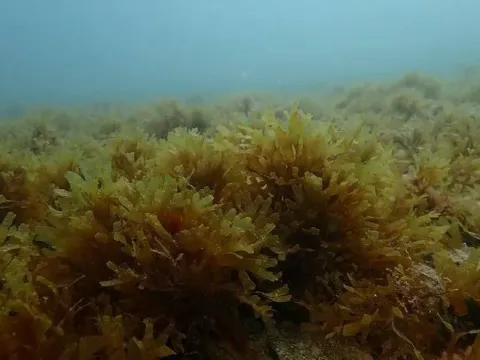
The most visible symptom of Rugulopteryx presence is the formation of dense, dark brown to olive mats that carpet the seafloor.
The thalli display a characteristic dichotomous branching pattern, creating thick, tangled masses that obstruct the original substrate entirely.
Mass accumulations of the alga often detach during high-energy events like storms, resulting in large rafts of decaying organic matter washing up on shorelines.
Affected areas show a notable loss of native biodiversity, as the invasion creates a monoculture that suppresses other marine organisms.
In the early stages of establishment, patches of the alga can be identified as brownish growths that quickly merge into a continuous and impenetrable layer.
Rugulopteryx flourishes in nutrient-rich coastal waters and is capable of colonizing a wide range of substrates, from rocky reefs to artificial structures.
Human activities, specifically maritime transport, are the primary vectors for long-distance dispersal, with spores and fragments transported via ship ballast waters.
The species demonstrates high environmental plasticity, thriving in varying conditions of depth and light, which facilitates its expansion into new oceanic niches.
Warmer temperatures in the Mediterranean have likely accelerated its growth cycle, allowing for year-round persistence in previously unsuitable habitats.
Lack of specialized grazers in the invaded range means that the species faces minimal biological pressure, leading to exponential population growth.
The ecological impact is profound, as the invasive alga creates shade and prevents the attachment and growth of native seaweed and sessile invertebrates.
It severely degrades marine habitats, reducing the structural complexity of ecosystems that many fish and crustacean species rely on for refuge and foraging.
Economic damages are significant, affecting local fisheries by clogging nets and altering the recruitment zones for commercially valuable fish populations.
Tourism is negatively affected due to the large-scale deposition of rotting algae on beaches, which results in significant cleanup costs and public health concerns.
The long-term shift toward a Rugulopteryx-dominated ecosystem represents a permanent loss of original biodiversity and a potential threat to regional food security.
Effective control measures are currently limited, as widespread chemical application is not viable due to the high risks of collateral environmental damage.
Management focuses on mechanical removal of the biomass in sensitive areas and early detection through continuous monitoring of coastal sites.
Stringent regulations for the management of ballast waters in maritime shipping are essential to curb further spread to uninvaded territories.
Research is actively exploring biological control methods, including identifying indigenous herbivores that might adapt to feed on the alga.
- Implementation of satellite-based monitoring systems.
- Public awareness campaigns to prevent accidental spread by recreational vessels.
- Development of local management protocols for beach restoration and cleanup.