
Xerocomus persicolor
Xerocomus persicolor
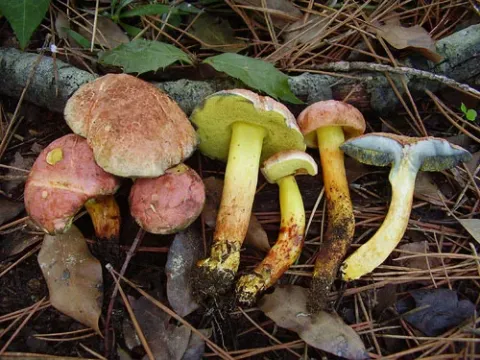
The mushroom Xerocomus persicolor is a small member of the Boletaceae family, typically featuring a cap diameter between 3 and 8 centimeters.
What the section contains
Xerocomus persicolor
The cap color ranges from reddish to pinkish-brown, and as the mushroom matures, the cuticle often cracks, revealing the yellowish flesh underneath.
The pore surface is bright yellow, showing little to no bruising when touched, which helps distinguish it from more reactive species of the genus.
The stipe is typically slender, sometimes slightly curved, and possesses a fibrous texture with yellowish hues that may have reddish fibrils.
The spores are olive-brown in mass, and the flesh is generally firm, possessing a mild odor characteristic of forest-dwelling boletes.
Xerocomus persicolor is strictly a fungus that thrives in forest environments and is not a pathogen causing any plant diseases.
It acts as a beneficial symbiont forming mycorrhizae with the roots of deciduous trees, rather than attacking the plant tissue.
It is not categorized as a threat to agricultural crops, and it does not produce toxins that result in necrotic lesions or plant decay.
Labeling this species as a plant disease is factually incorrect, as it plays a positive ecological role in nutrient cycling in forest soils.
Therefore, no plant protection measures are required for this species, as it does not interfere with the health of cultivated plants.
This mushroom favors damp environments within deciduous and mixed forests where there is a thick layer of organic litter.
Its fruiting bodies emerge predominantly during late summer and autumn when moisture levels are sufficient for development.
The species relies on stable soil moisture and moderate temperatures, as excessive heat or drought will inhibit its vegetative growth.
It forms mycorrhizal associations with specific tree species, meaning its occurrence is heavily dependent on the presence of healthy host trees.
Soil acidity is an important factor, with the fungus preferring slightly acidic to neutral substrates rich in decayed forest matter.