
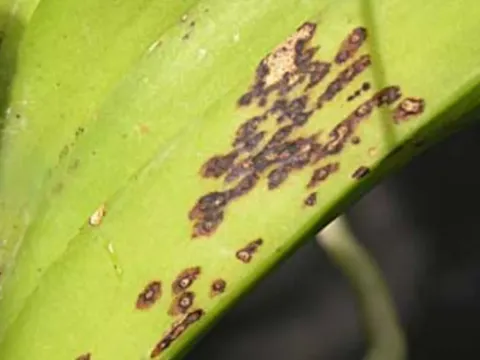
Phyllosticta leaf spot
Phyllosticta
The main symptom of Phyllosticta leaf spot is the appearance of circular or irregular spots on leaves, with colors ranging from light brown to dark brown. A lighter zone often forms in the center of older spots, surrounded by a darker border.
What the section contains
Phyllosticta leaf spot
A characteristic sign of the disease is the formation of pycnidia — tiny black dots that protrude above the surface of the infected tissue and serve as the fungus's spore-bearing organs.
As the infection progresses, the affected tissues begin to die, often falling out, which leads to holes in the leaf blade. In some crops, such as onions, garlic, or peanuts, spots may coalesce, causing premature wilting and drying of the foliage.
On stems and fruits (e.g., in papaya or watermelon), the disease manifests as sunken ulcers or necrotic areas, which significantly ruins the product's marketability.
Severe infection in ornamental species, such as Clerodendrum thomsoniae or Cyclamen persicum, leads to massive leaf drop and loss of aesthetic appeal.
The causative agents of the disease are imperfect fungi of the genus Phyllosticta. These are pathogens that lead a predominantly parasitic lifestyle, infecting living plant tissues.
The fungus's life cycle includes the formation of pycnidia, within which conidia mature — spores that facilitate the spread of infection throughout the growing season.
The infectious source most often persists in the form of mycelium and pycnidia on fallen leaves, in plant debris, and sometimes in the seeds of infected plants.
At the beginning of the growing season, spores are carried by raindrops, wind, or insects to healthy plants, where, in the presence of moisture, they begin to germinate and penetrate the epidermis.
The fungus has high plasticity and is capable of infecting a wide range of hosts, including vegetable crops, berries, and ornamental plants.
Phyllosticta development is favored by high air and soil humidity, creating an optimal environment for the germination of pathogen spores on the leaf surface.
The optimal temperature range for the fungus is between 20 and 25 degrees Celsius, although the disease can develop at lower temperatures under high humidity conditions.
Dense planting, poor ventilation in greenhouses, and improper watering (overhead irrigation on leaves) significantly accelerate the spread of the fungus within the plot.
Weakened plants suffering from nutrient deficiency or mechanical damage become the most vulnerable to Phyllosticta fungal infection.
In rainy years with frequent fog, the risk of epiphytotics of this disease increases significantly, especially in temperate regions.
The harm of the disease lies in a significant reduction of the assimilative leaf surface, which leads to a decrease in photosynthesis intensity and general weakening of the plant.
In affected vegetable crops, such as onions or peanuts, there is a significant reduction in yield due to premature death of the foliage.
The commercial quality of fruits and root crops deteriorates: when papaya or watermelon is infected by the pathogen, fruits lose weight, rot, and become unsuitable for storage or sale.
For ornamental plants, including Campanula carpatica and Cyclamen, Phyllosticta leaf spot causes a loss of decorative quality, leading to direct financial losses for nurseries.
Without control measures, the disease can destroy the entire harvest in protected ground conditions, spreading rapidly across large areas under high humidity.
The primary preventive measure is strict adherence to crop rotation, which prevents planting susceptible crops in the same location for at least 3-4 years.
It is necessary to carefully remove and destroy plant residues after harvest, as this is where the majority of the fungal infection stock overwinters.
It is important to use only healthy, tested seed and planting material to prevent the introduction of the pathogen into clean areas.
- Regular preventive spraying with copper-based preparations during periods of high humidity.
- Timely weeding of weeds that can act as infection reservoirs.
- Maintaining optimal plant density to improve airflow and ventilation.
If the first signs of the disease appear, the use of systemic fungicides approved for the corresponding crops is recommended.