
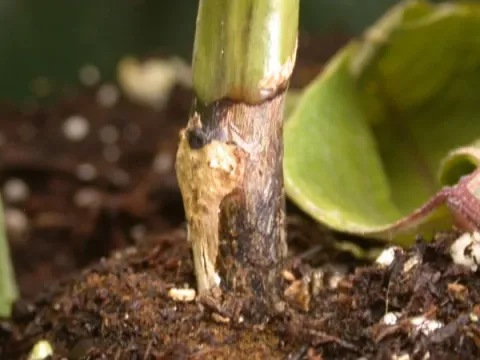
Rhizoctonia root rot
Rhizoctonia spp.
The disease is caused by the soil-borne fungus Rhizoctonia solani, a versatile pathogen known for its ability to survive in soil as sclerotia or mycelium on plant debris.
What the section contains
Rhizoctonia root rot
This fungus exhibits a wide host range, attacking various agricultural crops including onions, garlic, beets, asparagus, celery, peanuts, and oats.
It is classified as a systemic rot pathogen, specifically targeting the roots and lower stems, leading to severe decay of the plant's underground structures.
Because the fungus is a saprophyte, it can persist in the soil for several years even in the absence of a host crop, making it a persistent challenge for farmers.
Dissemination occurs primarily through infested soil, infected seeds, contaminated agricultural machinery, and surface runoff water.
Symptoms typically manifest as reddish-brown lesions on roots and stems, often leading to "damping-off" in seedlings and the collapse of young plants.
In mature crops, such as garlic or onions, the infection causes basal rot, where the base of the bulb turns soft and brown, eventually covered with fungal mycelium.
Above-ground signs include stunted growth, chlorosis, and general wilting, as the damaged root system is unable to provide adequate water and nutrients to the plant.
In conditions of high humidity, a characteristic white to brown web-like fungal growth may appear on the soil surface around the base of the affected stems.
- Lesions on the root system and taproots.
- Root decay and poor development of secondary roots.
- Brown necrotic patches on bulbs and tubers.
- Premature yellowing of leaves.
The development of Rhizoctonia is strongly favored by high soil moisture levels, especially during the early stages of plant growth and establishment.
The pathogen is most active at soil temperatures between +18°C and +25°C, making it particularly problematic during warm, wet spring or autumn seasons.
Compact, poorly aerated soils create anaerobic conditions that stress the plant and favor the rapid growth and spread of the fungal mycelium.
Short crop rotations involving susceptible species lead to a significant buildup of the pathogen's inoculum in the soil over time.
Mechanical injuries caused by soil insects or improper cultivation practices provide entry points for the fungus, facilitating rapid plant infection.
The primary damage caused by Rhizoctonia is the extensive loss of seedlings, leading to uneven stands and the economic cost of necessary field replanting.
It severely impacts the quality and marketability of produce, as bulbs and root crops often develop rot in storage, leading to massive post-harvest losses.
Infection weakens the overall vigor of crops, making them more susceptible to environmental stress and opportunistic secondary pathogens.
The disease reduces total biomass production and nutrient accumulation, negatively affecting the yield of crops like oats, sugar beets, and vegetables.
Contaminated fields require long-term management strategies, increasing production costs and limiting the choice of crops for subsequent seasons.
Implementing a balanced crop rotation is the most effective way to reduce the pathogen load in the soil by depriving the fungus of its host for several years.
Deep plowing and proper soil cultivation help bury crop residues, accelerating their decomposition and reducing the survival sites for the fungal sclerotia.
Seed treatment with effective fungicides is essential to provide early-season protection to germinating seeds and developing root systems.
Improving soil drainage and physical structure reduces waterlogging, which is a major factor in suppressing the development of Rhizoctonia root rot.
The use of biological control agents, such as Trichoderma species, has proven effective in suppressing R. solani and improving overall root health.