
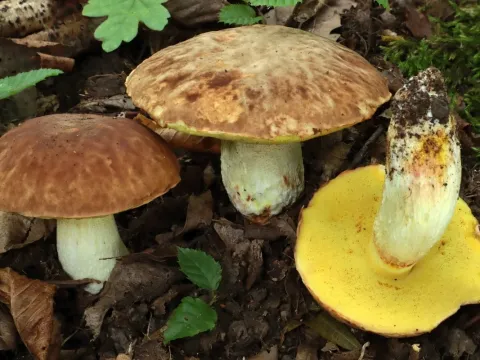
Xerocomus depilatus
Xerocomus depilatus
Xerocomus depilatus is a mushroom species belonging to the Boletaceae family. It is vital to state that this organism is not a plant disease, nor does it act as a pathogen for any agricultural, horticultural, or garden crops.
What the section contains
Xerocomus depilatus
The fungus functions primarily as a mycorrhizal partner to deciduous trees, particularly oaks. It lives in a symbiotic relationship, exchanging nutrients with the host tree's root system, which is a common and beneficial interaction in forest ecosystems.
The specific name depilatus refers to the lack of "hair" or fine scales on the cap surface. It is a strictly taxonomic designation used by mycologists to differentiate this species from other related boletes within the genus.
There is no evidence of this mushroom causing rot, necrosis, wilting, or any form of damage to living plant tissues. It does not produce phytotoxins and plays no role in the spread of plant infectious diseases.
From an agronomic perspective, Xerocomus depilatus is considered an ecologically neutral forest fungus. It does not require any pest management strategies, chemical treatments, or agricultural monitoring.
The fruit body typically features a convex cap, 5-12 cm in diameter, colored in shades of ochre, brown, or tawny yellow. The cap surface is often matte and prone to cracking during dry weather conditions.
Underneath the cap, the hymenium consists of yellow tubes. Upon mechanical injury or pressure, the flesh might exhibit a slight blue bruising, although this reaction is often weak compared to other boletes.
The stipe is firm, solid, and typically narrowed at the base. Unlike many other species in the Boletaceae family, the stipe of Xerocomus depilatus lacks a distinct reticulated pattern, appearing smooth or slightly wrinkled.
Spore production occurs during the summer and autumn months. The spores are deposited in an olive-brown mass, which is distributed naturally by wind currents within forested environments.
The presence of this fungus is strictly limited to the development of mushrooms on the forest floor. It does not cause symptoms on leaves, stems, or fruits of surrounding vegetation, as it is not a parasitic organism.
The development of Xerocomus depilatus requires specific environmental conditions found in deciduous forests. It depends heavily on the presence of symbiotic tree hosts, such as Quercus species.
The fungus thrives in humus-rich, well-drained soils with a neutral to slightly acidic pH level. It requires stable moisture levels, typically triggered by summer rainfalls, to stimulate the emergence of fruit bodies.
Temperature range is an important factor; the mycelium is most active during the warm period of the year, with optimal temperatures for fruit body formation between 15°C and 22°C.
It is rarely found in open-field environments due to the lack of symbiotic trees and the negative impact of agricultural activities, such as deep plowing and the application of synthetic fertilizers.
Habitat disturbance, such as deforestation or heavy soil compaction, effectively terminates the growth of the fungal mycelium in a given area, making the fungus sensitive to significant ecological changes.