
Striga
Striga spp.
Striga (Striga spp.), commonly known as witchweed, is a genus of parasitic plants in the Orobanchaceae family. These plants are obligate root parasites, meaning they must attach to a host plant to complete their life cycle.
What the section contains
Striga
The life cycle begins in the soil where Striga seeds remain dormant until they detect specific chemical signals, known as strigolactones, released by the roots of potential host plants like sorghum or maize.
Upon germination, the parasite develops a specialized structure called a haustorium. This organ penetrates the host root tissue, establishing a physiological connection to the host's xylem and phloem to extract water, nutrients, and photoassimilates.
Striga is exceptionally prolific, with a single plant producing hundreds of thousands of tiny, dust-like seeds. These seeds are easily dispersed by wind, water, and farm equipment, and they can persist in the soil for over a decade.
There are many species of Striga, but Striga hermonthica and Striga asiatica are the most economically significant, posing a massive threat to cereal production in tropical and subtropical regions worldwide.
Symptoms of Striga infestation are often misdiagnosed as drought stress or nutrient deficiency. Because the parasite attacks the root system below ground, visible damage to the foliage appears long before the weed emerges.
Infested crops such as maize, sorghum, and wheat exhibit severe stunting, leaf chlorosis, and wilting. Even with adequate irrigation, the host plant struggles because the parasite intercepts essential resources before they reach the plant's upper canopy.
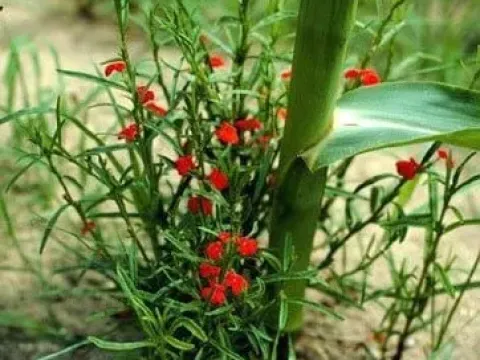
The most distinctive sign is the emergence of the bright, colorful flowers of the parasite around the base of the crop. These flowers appear several weeks after the initial attachment, indicating that the parasite has already caused significant damage.
In highly infested fields, the crop stands are sparse, and individual plants are significantly smaller than average. The root system of the affected host is often poorly developed, making it susceptible to lodging and further physiological collapse.
The presence of Striga can lead to a complete failure of the crop, as the plants are unable to produce grain due to the massive diversion of nutrients to the parasitic weed.
The damage caused by Striga is profound. Not only does it deplete the host of water and nutrients, but it also disrupts the host's hormonal signaling, leading to accelerated senescence and death of the crop.
Major crops affected include sorghum, maize, wheat, and tobacco. In endemic areas, yield losses can reach 100%, devastating food security and causing enormous economic losses for farmers who rely on these staple grains.
By damaging the root system, Striga makes the host plant vulnerable to other secondary infections and soil-borne pathogens. This synergy of stress factors quickly overwhelms the host, leading to rapid yield reduction.
The long-term impact on the soil is equally concerning. The accumulation of Striga seeds in the soil bank makes it difficult for future planting, often forcing farmers to abandon highly productive fields for many years.
Striga's ability to evolve and adapt to different environments and host genotypes complicates management, making it one of the most formidable challenges in modern agronomy.
Effective management requires an integrated approach that focuses on reducing the seed bank in the soil and preventing new infestations. Strict quarantine measures to avoid importing contaminated seeds are essential.
Crop rotation using "trap crops" like cotton, legumes, or sunflower is a highly effective strategy. These plants stimulate the germination of Striga seeds, but because the parasite cannot attach to them, the germinated seedlings eventually die.
Improving soil fertility, particularly through the application of nitrogen fertilizers, has been shown to reduce Striga incidence. High nitrogen levels can decrease the amount of strigolactones produced by the host roots, discouraging germination.
Chemical control using specific herbicides is possible but requires careful timing to prevent the weed from flowering and producing new seeds. Hand-pulling is common in small-scale farming, provided it is done before seed set.
Genetic improvement is the most sustainable solution. Research is focused on developing host cultivars that are resistant to penetration or that have lower rates of strigolactone exudation, effectively becoming invisible to the parasite.