
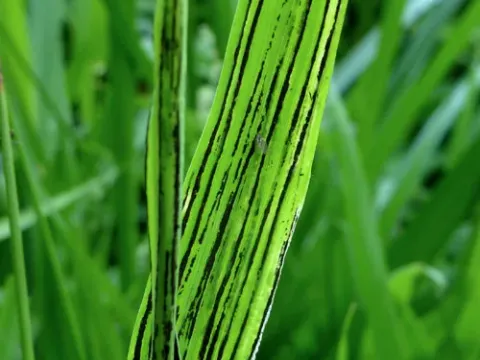
Stripe smut
Ustilago striiformis
The causal agent of stripe smut is the fungus Ustilago striiformis, a member of the Ustilaginaceae family. This pathogen is a specialized parasite that primarily attacks a wide range of perennial grasses and cereal crops, systematically colonizing their internal tissues.
What the section contains
Stripe smut
The fungus is characterized by its systemic growth pattern; once it infects a seedling, the mycelium spreads throughout the plant, persisting in the meristematic tissues and growing along with the host throughout the entire season.
Reproduction is carried out through teliospores, which form in elongated sori beneath the epidermis of leaves and leaf sheaths. Upon maturation, these spores are released into the environment, where they can be dispersed by wind, water, or mechanical equipment to initiate new infections.
Ustilago striiformis is capable of surviving as dormant spores in the soil for several years. This persistence makes it a long-term threat to susceptible grass species, particularly in areas where crop rotation is neglected or poorly managed.
Infection typically occurs in the germinating seedling stage. The fungus enters the plant through the crown or root tissues, eventually developing into the systemic mycelium that characterizes the disease's later stages of progression.
The primary symptom of stripe smut is the development of narrow, chlorotic streaks that run parallel along the leaf blades and sheaths. These streaks eventually turn gray and then black as the fungal spores develop and mature underneath the epidermis.
As the spores mature, the epidermis ruptures, exposing the dark, powdery mass of teliospores. The infected leaves often become curled, brittle, and exhibit premature senescence, leading to significant loss of photosynthetic efficiency.
Affected plants often display stunted growth, reduced tillering, and general lack of vigor. In severe cases, the infected grass may fail to produce seed heads or exhibit distorted floral structures that are replaced by fungal sporulation.
Unlike loose smut, which is confined to the inflorescence, stripe smut affects the vegetative tissues of the grass. This distinctive striping pattern is the most reliable visual diagnostic marker for identifying the disease in the field.
Infected stands often appear patchy and thin. Because the fungus is systemic, the symptoms remain visible throughout the growing season, particularly during the cooler, more active growth periods of the host plant.
Stripe smut development is highly dependent on environmental conditions, particularly favoring cool, moist weather during the germination and early seedling stages. Optimal infection temperatures range between 10 to 15 degrees Celsius.
High soil moisture is a critical factor, as it facilitates the germination of teliospores and the subsequent penetration of the infection hyphae into the young grass seedlings. Rainy spring weather significantly exacerbates the incidence of the disease.
Poorly drained soils or sites with high humidity levels create an ideal microclimate for the pathogen. In such conditions, the fungal spores can easily spread from one plant to another, leading to increased disease severity within the stand.
Excessive nitrogen fertilization, while boosting growth, can sometimes render plants more susceptible by delaying maturation and creating lush, dense tissues that are easier for the pathogen to colonize.
The disease is most prevalent in environments where the host plant is stressed by cold or prolonged wet conditions. Conversely, hot and dry weather during the seedling phase often inhibits the progression of the fungus, providing a natural check on the disease.
The economic impact of stripe smut is primarily felt in forage production and turf management. Infected grasses lose nutritional value, and severe outbreaks can lead to the thinning of pastures, necessitating costly re-seeding and land reclamation efforts.
In seed production fields, the disease causes substantial yield losses as the fungus displaces grain, resulting in poor seed quality or total crop failure. The presence of spores also complicates the processing and marketing of contaminated batches.
Systemic infection weakens the root system of perennial grasses, making them less competitive against weeds and more prone to decline under drought or environmental stress. This results in the progressive degradation of the grassland ecosystem.
The cumulative effect of infection leads to reduced biomass production, which is a major concern for the livestock industry. Contaminated hay can also pose potential health risks to livestock if consumed in large quantities.
Furthermore, the increased reliance on fungicides and intensive field management adds to the operational costs for farmers and land managers attempting to mitigate the spread of the pathogen.
The cornerstone of stripe smut control is the use of disease-free, certified seeds. Treating seeds with systemic fungicides before planting is a highly effective method to prevent early-stage infection and protect the vulnerable seedling.
Implementing a rigorous crop rotation schedule is essential to disrupt the life cycle of the fungus and reduce the spore load in the soil. Avoiding continuous cropping of susceptible grasses is a primary preventive measure.
Good agronomic practices, such as providing adequate drainage and avoiding over-compaction of the soil, help to maintain healthy plant growth and reduce the moisture-related advantages that the pathogen exploits.
Planting resistant varieties or hybrids is the most sustainable and efficient strategy for managing stripe smut. Breeding programs focused on genetic resistance have made significant strides in protecting cereal crops from this pathogen.
Regular monitoring of fields and the prompt removal of heavily infected clusters can help to limit the localized spread of the disease. In some cases, localized soil treatments may be necessary to suppress the spore population in endemic areas.