
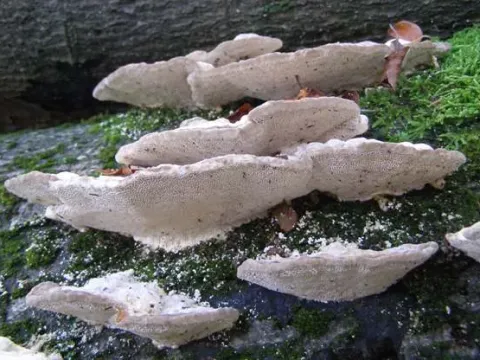
Trametes gibbosa
Trametes gibbosa
The causal agent of this disease is the wood-decay fungus Trametes gibbosa, which belongs to the Polyporaceae family. It is a saprotrophic basidiomycete that thrives primarily on dead wood but can also attack weakened living trees.
What the section contains
Trametes gibbosa
The fungus is known for causing white rot in woody materials. It possesses an advanced enzymatic system that allows it to break down lignin and cellulose, effectively decomposing the wood structure until it becomes soft and fibrous.
The life cycle of the fungus begins with the dispersal of basidiospores carried by wind, which colonize exposed wood surfaces or bark injuries. The mycelium penetrates deep into the stem, colonizing the wood tissue over time.
The fruiting bodies are perennial and recognizable by their distinct hump-like shape near the base of attachment. They are typically whitish to cream-colored and often appear in clusters on tree trunks.
While playing an essential role in forest nutrient cycling by decomposing dead logs, this fungus is considered a harmful pathogen in orchards and managed forests where it compromises timber quality and tree longevity.
The most prominent sign of infestation is the appearance of characteristic fruiting bodies on the trunk. These are semi-circular, tough in texture, and feature a noticeable hump, which is a diagnostic feature of this species.
The internal part of the affected wood appears bleached or whitish and develops a stringy or fibrous texture. This occurs because the fungus degrades lignin while leaving altered cellulose, leading to a loss of structural integrity.
In the early stages, one may notice discoloration of the bark and localized drying. As the infection progresses, cracks may form in the trunk, often filled with white or cream-colored mycelial mats.
Trees heavily infested with the fungus often show signs of decline, including premature leaf fall, wilting of skeletal branches, and overall thinning of the crown due to nutrient blockage.
- Development of whitish or cream-colored hump-shaped fruiting bodies.
- Bleaching and fibrous texture of the internal wood.
- Cracking of the trunk as wood strength decreases.
- Peeling of bark in infected areas.
- General decline in tree vitality and branch dieback.
Trametes gibbosa flourishes in high-humidity environments with moderate temperatures. It is most active in dense stands with poor air circulation where moisture is retained for longer periods.
Infection usually occurs through wounds on the tree trunk caused by wind damage, frost, or mechanical injuries from equipment. These openings provide an easy entry point for basidiospores.
Weakened trees, particularly those suffering from drought stress or nutrient deficiencies, have lower resistance to fungal invasion compared to healthy, vigorous trees with intact bark barriers.
Spore dispersal peaks during spring and autumn when rainfall increases and environmental humidity is optimal for spore germination on available wood surfaces.
Proximity to existing infection sources, such as old stumps or decaying logs, significantly increases the risk of contamination for nearby living trees in a plantation or garden.
The primary impact is the rapid decay of internal wood, which compromises the tree’s mechanical strength. This significantly increases the risk of windthrow and sudden stem breakage, posing a safety hazard.
In the timber industry, infection leads to severe economic losses as the affected wood loses all commercial value. Once infested, the lumber is typically unsuitable for construction or fine woodworking.
The fungus degrades the aesthetic value of parks and urban landscapes. Infested trees often become hazardous, necessitating costly removal to prevent accidents in public areas.
Furthermore, the weakened state of the tree makes it highly susceptible to secondary attacks by wood-boring insects, which accelerate the process of total tree death.
If not managed, the accumulation of decayed wood in an area leads to further spore production, creating a cycle of infection that can decimate entire sections of a woodland or orchard.
The most effective control measure is rigorous sanitation: removing and destroying infected logs, stumps, and heavily damaged trees to eliminate the source of infection.
Preventing mechanical damage to trunks during agricultural or maintenance work is crucial. Proper pruning techniques and the use of protective tools can minimize the number of open wounds.
For minor wounds, clean the affected area back to healthy tissue and apply an appropriate fungicide or wound sealant to prevent fungal colonization and spore penetration.
Maintain tree health through adequate irrigation, fertilization, and pest management. A healthy tree with a robust defense system is much better equipped to resist infection by wood-decay fungi.
In cases where valuable trees are partially affected, surgical removal of decayed tissue followed by disinfection may be attempted to prolong the life of the tree, although total removal is often more practical.