
Trametes ljubarskyi
Trametes ljubarskyi
Description
Symptoms
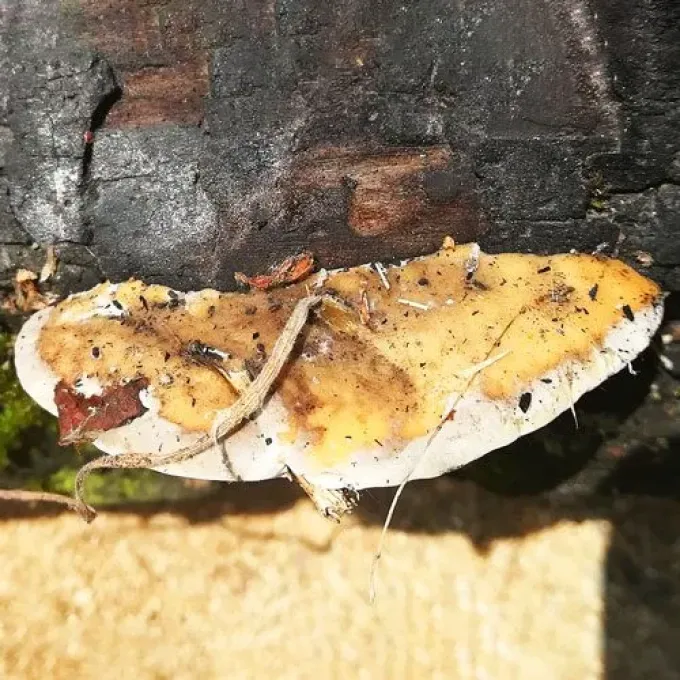
Trametes ljubarskyi manifests through the formation of perennial fruiting bodies on the trunks of infected trees. These structures are typically hoof-shaped or resupinate, often found in overlapping tiers.
The surface of the caps displays characteristic zonation and fine pubescence. The context (inner tissue) is rigid, corky, and ranges from light brown to dark brown, serving as a key diagnostic feature.
The interior of the wood undergoes intense degradation, leading to the development of typical white rot. Infected wood loses its structural integrity, becomes fibrous, and turns yellowish-white with distinctive dark lines.
External signs of the disease become apparent only in advanced stages, when mycelium penetrates deep into the heartwood. Frequently, fungal sporulation can be observed around old knots or cracks in the bark.
In the final stage, the tree loses mechanical stability, leading to windthrow or trunk fracture even under moderate wind conditions, posing a significant risk in wooded areas.
Pathogen
The pathogen responsible is the wood-destroying fungus Trametes ljubarskyi, a member of the Basidiomycota division. It acts as an aggressive xylotroph specialized in decomposing woody tissues.
The fungus primarily targets deciduous tree species, especially poplars, willows, and other dominant forest species. It functions as a facultative parasite, capable of surviving as both a parasite and a saprotroph.
The life cycle includes a vegetative phase inside the wood and a sporulation phase. Basidiospores spread via air currents, infecting trees through mechanical wounds or bark fissures.
The fungus produces enzymes capable of breaking down lignin and cellulose, allowing it to efficiently assimilate wood substances and cause rapid destruction of the fiber structure.
The biology of the pathogen is closely linked to the host's condition; it usually colonizes weakened or damaged specimens but can eventually spread to healthy parts of the tree.
Conditions for development
The development of Trametes ljubarskyi is favored by high air humidity and moderate temperatures, typical of forest ecosystems. Optimal conditions for spore germination occur during prolonged rainy periods.
The presence of entry points is a critical condition for infection. These can include pruning wounds, frost cracks, sunscald, or damage caused by boring insects or wild animals.
Dense, overcrowded plantations with poor air circulation create a microclimate that is highly conducive to spore germination and the development of new fruiting bodies.
Physiological weakening of trees due to unfavorable soil and climatic conditions makes them more susceptible to the penetration and establishment of the fungal mycelium.
The fungus remains active throughout the growing season, though the most intensive growth of fruiting bodies is typically observed in autumn when humidity levels are high.
Why it matters
The primary danger lies in the extensive destruction of wood, which renders it unsuitable for commercial use and significantly reduces the timber value of the stand.
Infection leads to premature dieback, disruption of physiological metabolic processes, and stunted growth of the affected tree populations.
Damaged trees serve as infection reservoirs for neighboring healthy plants, facilitating the rapid spread of the disease throughout the forest or shelterbelt.
Reduced mechanical strength of the trunks creates a serious safety hazard, as infected trees are prone to sudden failure, which is particularly dangerous in recreational zones.
The damage also manifests in the alteration of forest phytocenosis composition, as susceptible species are replaced by less commercially valuable or different plant types.
Protection
Sanitary logging is the primary management tool, aimed at removing infected trees to reduce the overall inoculum load within the forest stand.
It is essential to properly seal and disinfect mechanical wounds on trunks to prevent the entry of fungal spores into the plant tissues.
Planned forest management, including thinning, improves air circulation and creates environmental conditions that are less favorable for fungal development.
Maintaining optimal water balance in plantations is crucial to prevent tree stress, which inherently increases susceptibility to fungal pathogens.
- Regular monitoring of phytosanitary conditions.
- Prompt removal and disposal of fungal fruiting bodies.
- Application of fungicides on pruning cuts.
- Selection of resistant tree species for new plantations.
Discussion
No discussions yet — be the first.