
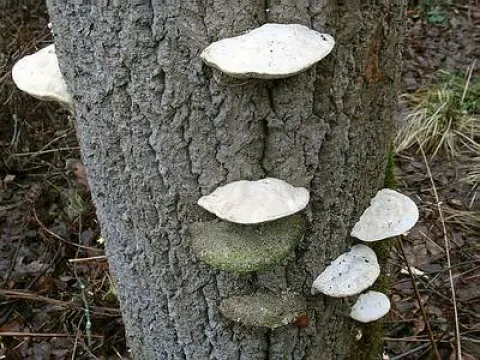
Trametes suaveolens
Trametes suaveolens
The causal agent of this disease is the wood-decaying fungus Trametes suaveolens, which belongs to the Polyporaceae family. This is a perennial fungus that primarily targets deciduous tree species.
What the section contains
Trametes suaveolens
Biologically, this species is classified as a facultative parasite or saprotroph. It develops within the living wood of host trees but can continue its life cycle on dead wood remnants.
The fungal mycelium penetrates deep into the stem structure, decomposing cellulose and lignin. Through its metabolic processes, the fungus secretes enzymes that cause the structural destruction of plant tissues.
On the bark surface, fruiting bodies emerge as shelf-like or cap-shaped structures. Their surface is usually smooth or slightly velvety, ranging in color from white to creamy.
One of the most notable characteristics of this species is the distinct aniseed aroma emitted by fresh fruiting bodies, which serves as a reliable field identification marker.
The primary external sign of infection is the appearance of perennial fruiting bodies on trunks or thick branches. These are often found in clusters, typically near mechanical wounds or frost cracks.
Internal tissues of the tree suffer from intense white corrosive rot. The wood becomes soft, loses mechanical strength, and develops a light hue marked by characteristic black mycelial lines.
In the early stages of infestation, there are no visible symptoms as the fungus grows internally. As the disease progresses, the tree starts to wilt, with leaves yellowing prematurely and the canopy thinning.
Affected wood becomes brittle, leading to the breakage of trunks during high winds. This poses a significant safety risk to the tree itself and the surrounding environment.
- Distinct aniseed smell near the fruiting bodies.
- Presence of concentric zones within the cross-section of decayed wood.
- Bark cracking and sap leaking in zones of active fungal growth.
The development of Trametes suaveolens is favored by high humidity and moderate temperatures, which are characteristic of regions with widespread willow cultivation. Spores are dispersed through the air.
The primary entry points for the infection are any breaches in the bark, such as pruning cuts, accidental mechanical injuries, or winter-related splitting.
Weakened trees, suffering from nutrient deficiencies or environmental stress like drought or flooding, are significantly more susceptible to infection than healthy individuals.
Dense, poorly ventilated stands create an ideal microclimate for spore germination. Overmature trees, which often have a softer internal structure, are colonized by the mycelium more rapidly.
The life cycle of the fungus can span many years. If favorable conditions persist, fruiting bodies can enlarge annually, releasing new waves of spores throughout the entire growing season.
The primary danger lies in the rapid degradation of willow and poplar wood. Infected logs become unsuitable for industrial or timber use due to structural instability.
The decay of the root system and the base of the trunk leads to structural failure. This creates major risks in urban parks and along roadways where falling trees could cause property damage or harm.
In forest nurseries, this fungus can cause widespread loss of seedlings, resulting in severe economic impacts on timber production and forest management.
The disease weakens the tree's overall immunity, making it more vulnerable to secondary pests, including wood-boring insects and other competitive fungal species.
Because the systemic damage is often irreversible, the fungus eventually leads to the death of the tree, requiring the removal of infected individuals from the stand.
The primary management measure is sanitary thinning and the immediate removal of infected trees to prevent further spore dispersal to healthy neighbors.
Proper pruning techniques are essential; all cuts must be clean and immediately treated with appropriate disinfectants or wound paints to block fungal entry.
Preventing mechanical damage to the bark during agricultural operations or livestock grazing is a critical component of disease prevention in orchards and woodlands.
In commercial plantations, maintaining appropriate stand density ensures sufficient air circulation, which hinders the successful germination of spores on damp bark surfaces.
Regular phytosanitary inspections help identify early signs of fungal activity, allowing for rapid intervention before the pathogen can penetrate deep into the internal wood tissues.