
Tranzschelia
Tranzschelia
The disease is caused by the pathogenic fungus Tranzschelia pruni-spinosae, a member of the Basidiomycota phylum. It is a specialized rust fungus that requires specific conditions to complete its complex lifecycle.
What the section contains
Tranzschelia
The primary hosts of this pathogen are plants of the Prunus genus, including plums, apricots, peaches, and almonds. The fungus targets the foliage, disrupting essential physiological processes within the tree.
The lifecycle may involve an alternate host from the Ranunculaceae family in some regions, but in orchard environments, it frequently persists independently through repeated cycles of urediniospores on stone fruit hosts.
Overwintering typically occurs as teliospores on fallen leaves or as mycelium within the bark of twigs. In spring, these spores are dispersed by wind and splashing water, initiating new infections on developing foliage.
The fungus invades plant tissue by sending haustoria into the cells to extract nutrients. This localized infection spreads rapidly under favorable conditions, creating a high-pressure disease environment for the orchard.
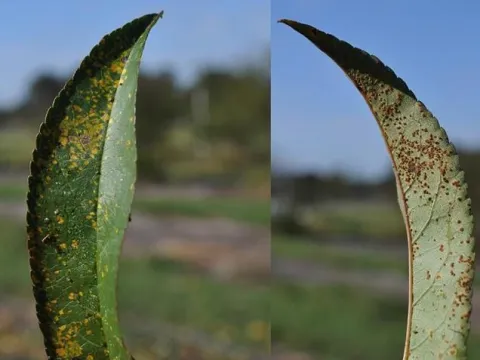
The initial symptoms appear in early summer as small, chlorotic, or yellowish spots on the upper leaf surface. Soon after, the corresponding underside of the leaf shows distinct pustules filled with spores.
A hallmark sign of the infection is the development of a reddish-brown, powdery coating on the undersides of leaves, consisting of masses of urediniospores. These rust-colored pustules may eventually coalesce.
As the disease progresses, leaves begin to yellow prematurely and drop from the tree, often occurring in mid-to-late summer. This leads to early defoliation, which severely compromises the tree's health.
In severe cases, the rust can affect fruit and young shoots. Affected fruit often exhibits lesions, dimples, or deformations, rendering them unmarketable and susceptible to secondary decay organisms.
- Yellow spots on the upper leaf surface.
- Rust-colored powder on the underside of leaves.
- Premature leaf drop in late summer.
- Deformed, unmarketable fruit.
Tranzschelia thrives in environments with high relative humidity and frequent rainfall. Prolonged periods of dew or morning fog during late spring and early summer are highly conducive to spore germination.
Optimal temperatures for spore development and infection range between +18 and +22 degrees Celsius. Within this temperature range, the fungus can complete its reproductive cycle very quickly.
Dense tree canopies resulting from improper pruning reduce airflow, trapping humidity within the foliage. This microclimate significantly accelerates the spread of rust compared to well-ventilated trees.
Poor orchard sanitation, specifically leaving infected leaf litter on the ground throughout winter, ensures a high inoculum load for the following season. These spores remain viable in decaying organic matter.
Nutritional imbalances, particularly excess nitrogen and potassium deficiency, can weaken the plant's natural defenses. Stressed or overly vigorous trees with lush, succulent growth are often more susceptible to infection.
The primary impact of Tranzschelia is early defoliation, which severely hinders the tree's ability to photosynthesize. This results in reduced carbohydrate storage, leading to poor tree vitality.
Reduced vigor makes trees highly vulnerable to winter injury, as they fail to reach proper dormancy levels. Significant dieback of twigs and buds is a common long-term consequence of repeated infestations.
Fruit damage directly affects economic returns, as deformed or spotted fruit cannot be sold as fresh produce. Furthermore, infected fruit may suffer from lower sugar content and poor quality.
Persistent infections weaken the tree's overall immune system, increasing its susceptibility to other diseases and environmental stressors. This effectively shortens the productive lifespan of the entire orchard.
Economic losses arise from both direct harvest reduction and the increased costs of necessary fungicidal applications required to manage the recurring disease cycle.
Cultural practices are essential for control, beginning with the thorough removal and destruction of all fallen leaf litter in the autumn to eliminate the primary overwintering source of the fungus.
Regular pruning is vital to open the canopy, improve airflow, and increase light penetration. This helps dry out the foliage faster after rain or dew, creating conditions that are unfavorable for fungal growth.
Chemical control involves the timely application of fungicides, particularly triazoles or strobilurins, during the vegetative season. Treatments should be applied preventively or at the very first sign of rust.
Maintaining a balanced fertilization program focusing on potassium and phosphorus helps strengthen plant tissue. Avoiding excessive nitrogen fertilization limits the growth of soft, susceptible leaves.
In integrated pest management, monitoring for alternate hosts (like wild Ranunculus species) near the orchard perimeter can help reduce the overall disease pressure on the stone fruit trees.