
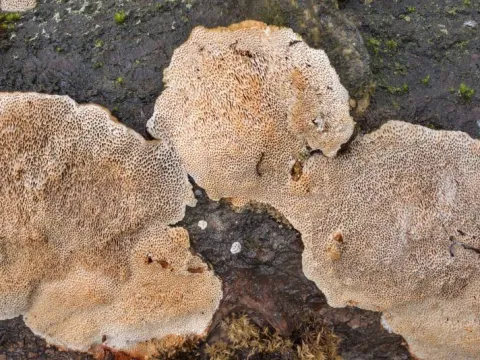
Trametes trogii
Trametes trogii
The causative agent of the disease is the wood-decay fungus Trametes trogii, a member of the Polyporaceae family. It is a saprotrophic and parasitic basidiomycete that thrives on woody substrates.
What the section contains
Trametes trogii
The fungus is known for inducing white rot, where it primarily degrades lignin and cellulose within the host's wood, compromising its internal structure.
The primary reproductive structures, the fruit bodies, appear on the bark of infected trees. These structures release basidiospores that are disseminated by wind to new infection sites.
Once settled on damaged wood, the spores germinate, and the mycelium begins to penetrate deep into the sapwood and heartwood of the tree.
As a specialized wood-decay pathogen, it effectively decomposes dead wood but often exploits wounded or stressed living trees to colonize and spread further.
The most visible symptom is the formation of dense clusters of leather-like or hairy brackets on the surface of tree trunks and branches.
The caps are characterized by a distinct brownish or ochre color and a hairy texture, which serves as a vital feature for field identification.
Internally, the wood loses its structural integrity, appearing bleached or white with a fibrous texture, indicating the chemical breakdown of the wood components.
Infected trees often exhibit thinning foliage, yellowing leaves, and premature dieback of branches due to the impairment of vascular transport systems.
Advanced stages of the disease manifest as large hollows or cavities in the main trunk, making the tree structurally unstable and prone to snapping.
High humidity and poor ventilation are the primary environmental drivers that favor the germination of fungal spores and the development of mycelium.
Open wounds on the bark, caused by improper pruning, frost cracks, or mechanical damage, provide a direct entry point for the pathogen.
Temperate climate conditions with steady moisture levels allow the fungus to remain active throughout most of the growing season.
Overcrowded plantations or orchards with limited airflow create a stagnant microclimate that accelerates the spread of the fungus among neighboring trees.
The presence of decomposing logs, stumps, and fallen branches in the vicinity maintains a high inoculum load, posing a constant threat to nearby healthy plants.
The primary damage involves the destruction of the tree's internal core, which reduces the plant's structural strength and increases the danger of windthrow.
The pathogen severely diminishes the lifespan of orchard trees, leading to economic losses and the need for frequent replacement of the affected stock.
As the rot spreads, the tree's physiological health declines, resulting in poor growth, reduced fruit quality, and increased susceptibility to other diseases.
The fungus acts as a long-term threat to the entire ecosystem, as it can persist in the environment for many years, continuously releasing spores.
In urban and landscape settings, the presence of this fungus on trees represents a significant safety hazard for people and property due to potential branch or tree failure.
Effective management begins with strict sanitation practices, including the immediate removal and destruction of infected branches and dead wood from the orchard.
All pruning wounds should be sealed with wound paints or fungicides to prevent spores from infiltrating the exposed wood tissues.
Proper orchard hygiene is essential; removing stumps and debris eliminates the food sources that allow the fungus to persist and thrive.
Boosting tree immunity through adequate fertilization and balanced irrigation helps the plants resist fungal colonization more effectively.
- Regular inspection of trees for signs of fungal brackets.
- Sterilization of pruning tools to prevent cross-contamination.
- Protection of the bark from mechanical damage and sunscald.
- Timely removal of severely infected, non-recoverable trees.