
Trapelia
Trapelia
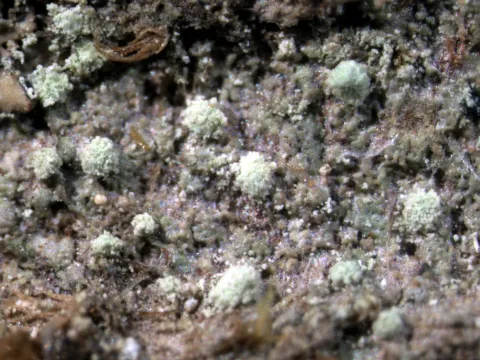
Trapelia is a genus of crustose lichens frequently observed on the bark of mature trees. They appear as flat, granular, or cracked patches that adhere firmly to the substrate, often forming intricate patterns.
What the section contains
Trapelia
The thallus color usually ranges from white to grey or greenish-grey. Under close inspection, one can often see small, disc-like apothecia (fruiting bodies) that are characteristic of this genus.
Unlike parasitic fungi, these lichens do not invade the living tissues of the host tree. They remain strictly on the outer surface of the bark, meaning they do not cause necrosis or rot.
The growth is typically very slow. Older colonies can cover significant portions of the trunk, often surrounded by a darker prothallus that marks the edge of the growth.
The presence of these lichens often indicates a mature tree with a stable bark surface and a relatively humid, unpolluted environment.
Trapelia is not a plant pathogen. It is a symbiotic organism consisting of a fungus and a photosynthetic partner (algae). They derive all their nutrients from the atmosphere and trapped particles.
They do not utilize the tree as a food source, but merely as an anchor. They are classified as epiphytes rather than parasites, as their survival does not depend on the tree's internal resources.
Reproduction occurs via spores carried by the wind or through small fragments of the thallus that detach and establish new colonies in damp areas.
Biologically, they belong to the family Trapeliaceae. Their colonization of tree bark is a natural ecological process rather than an infectious disease cycle.
Misidentifying lichens as fungal pathogens can lead to the unnecessary and harmful use of chemicals. It is essential to recognize them as harmless residents of the tree bark.
High humidity and consistent moisture on the bark surface are the primary drivers for the establishment and growth of Trapelia colonies.
They prefer sheltered, shaded areas of the tree where moisture evaporation is slow. Direct, harsh sunlight often inhibits their ability to colonize and thrive.
Older trees with rough, fissured bark provide the perfect anchor points where dust and moisture accumulate, fostering the development of lichen thalli.
The genus is known to be sensitive to air pollution. Their presence is often considered a sign of good local air quality, as they do not tolerate high levels of industrial emissions.
Gardens with poor airflow due to overly dense canopies create a stagnant microclimate that is ideal for the colonization of these epiphytes.
Trapelia causes no direct damage to the physiological functions or structural integrity of the tree. They do not penetrate the cambium or extract sap.
The potential indirect harm is limited to the lichen providing cover for overwintering pests, such as scales or mites, which may find protection under the lichen's crust.
Excessive coverage on a tree trunk may lead to aesthetic concerns for homeowners and may slightly hinder the bark's ability to dry quickly after rain.
There is no evidence to suggest that the presence of Trapelia reduces fruit yield or weakens the growth of healthy trees.
For most agricultural applications, the presence of these lichens is simply an indicator of the need for better general maintenance and orchard hygiene.
The most effective management strategy is manual removal. This can be achieved by gently brushing the bark with a stiff bristle brush during the dormant season.
Whitewashing tree trunks with a lime-based solution helps to modify the bark's pH and prevents new lichen spores from establishing themselves on the surface.
- Perform regular pruning to increase air circulation within the tree canopy.
- Maintain tree vigor through proper fertilization and watering.
- Ensure the garden environment is well-managed to prevent excessive local humidity.
Systemic fungicides are not required and are not effective against lichens. Focus should remain on good horticultural practices.
Regular monitoring of tree health ensures that any underlying issues, which might encourage excessive colonization, are addressed promptly.