
Tapinella
Tapinella
The genus Tapinella (Latin: Tapinella) belongs to the division Basidiomycota and comprises fungi that are specialized saprotrophs capable of decomposing wood. The most recognized species is Tapinella panuoides.
What the section contains
Tapinella
Biologically, these fungi act as wood-decay agents that cause brown rot. Their mycelium infiltrates the cellular structure of wood, breaking down cellulose while leaving lignin intact, which fundamentally changes the timber's physical properties.
Unlike many parasitic fungi, Tapinella is typically a saprotroph that grows on dead or weakened coniferous wood but can colonize building timber if environmental conditions are conducive.
The fungus develops an extensive network of mycelial strands that allow it to spread across substrates and explore new nutrient sources effectively.
Reproduction occurs through spores carried by wind currents, ensuring high durability and widespread occurrence in forest environments and timber storage facilities.
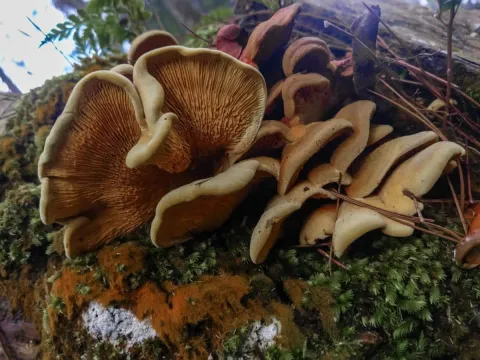
The main visible sign of Tapinella is the emergence of fan-shaped or funnel-shaped fruit bodies that often grow in dense, fused clusters.
The upper surface of the cap is typically velvety or felt-like, while the underside features complex, branched folds that radiate from the point of attachment.
Wood affected by Tapinella changes color, developing the characteristic brown hue of brown rot, and gradually becomes brittle, eventually cracking into cubical sections.
Dense mats of white or yellowish mycelium can often be found within the timber, penetrating deep into the internal wood structure.
In closed areas, the fungus can be detected by a specific musty odor associated with decomposing wood, especially in locations with poor airflow.
High moisture levels are critical for the growth and development of Tapinella, as it is highly sensitive to the water content of its substrate.
The optimal temperature for mycelial growth ranges from +15 to +25 degrees Celsius, allowing the fungus to flourish during warm, humid seasons.
The fungus most frequently colonizes softwood species such as pine and spruce, particularly when they are kept in shaded, damp environments with inadequate ventilation.
In natural forests, Tapinella is commonly found on stumps, fallen logs, and logging debris that remain in contact with damp soil.
Structural timber becomes vulnerable to Tapinella in cases where foundations lack proper waterproofing or where buildings suffer from chronic condensation issues.
The primary threat posed by Tapinella is the accelerated degradation of wooden structural elements, which can compromise their load-bearing capacity and lead to collapse.
In the forestry industry, this fungus leads to substantial economic losses by reducing the quality and commercial value of stored timber and lumber.
While the fungus rarely attacks healthy, living trees, its presence in forest stands indicates an accumulation of deadwood and poor management of woody debris.
The presence of mass spore production in residential areas may pose health risks, as spores can trigger allergic reactions in sensitized individuals.
Decay products left by the fungus create an environment conducive to secondary colonization by other opportunistic microorganisms, further complicating remediation efforts.
The cornerstone of protection is maintaining dry wood conditions; lumber should be stored in well-ventilated areas using pallets or raised platforms.
Regular application of wood preservatives and fungicides is essential during the construction phase to prevent mycelial penetration into the timber structure.
In forest management, timely removal of logging debris and sanitary clearing are necessary to prevent the buildup of potential fungal habitats.
If an infestation occurs, affected wood must be removed immediately, and the surrounding area must be thoroughly dried to halt any further mycelial spread.
- Application of specialized wood fungicides based on copper or boron.
- Ensuring proper ventilation in basements and attic spaces.
- Effective waterproofing of foundations and wooden floor beams.
- Routine inspection of timber components for early signs of fungal growth.