
Taro leaf blight
Phytophthora colocasiae
Description
Symptoms
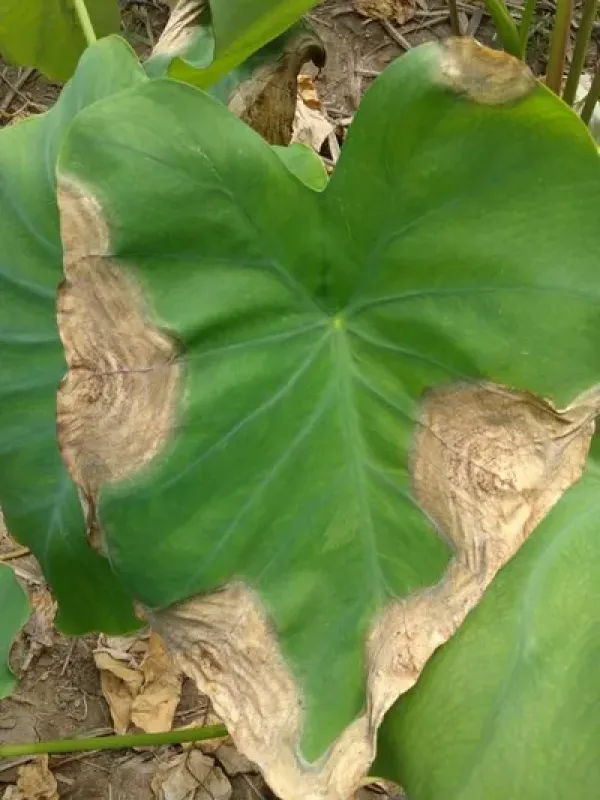
Initial symptoms consist of small, dark, water-soaked spots on the leaf blades. These spots enlarge rapidly, often forming concentric patterns, and develop a dark brown or purplish color surrounded by a yellow halo.
A dense, white, downy growth of sporangia often appears on the underside of the leaves in the infected zones, particularly during periods of high humidity. This represents the active sporulation phase of the disease.
As the infection progresses, petioles become necrotic, causing them to collapse and leading to the premature death of the entire leaf rosette. If the pathogen reaches the corm, it causes internal browning and a soft, foul-smelling rot.
Cross-sections of infected corms show diffused zones of decay, turning the healthy flesh into a mushy, brown mass. This internal rotting makes the produce entirely unmarketable and inedible.
Severe infestations give the field a scorched, burned appearance. The rapid spread of these symptoms often leads to total crop failure within a few weeks if weather conditions remain favorable for the pathogen.
Pathogen
The disease is caused by the oomycete Phytophthora colocasiae. This pathogen is a water mold that acts as an obligate parasite, thriving particularly in warm and humid tropical environments where it can replicate rapidly.
The life cycle involves the production of sporangia, which are disseminated via rain splash, wind, or movement of infected planting materials. In the soil, the pathogen persists through oospores that can survive adverse conditions until a new host is available.
The primary host is Colocasia esculenta (taro). The pathogen is highly destructive, affecting leaves, petioles, and corms, making it a major threat to global taro production and local food security.
Infection begins when zoospores germinate on plant surfaces in the presence of water films. The pathogen rapidly penetrates the leaf tissue, leading to a fast progression of the disease throughout the plant.
Given the genetic diversity of Phytophthora colocasiae, the pathogen can adapt to different environmental conditions and potentially overcome partial host resistance, necessitating continuous breeding and management efforts.
Conditions for development
The development of taro leaf blight is heavily dependent on high moisture levels and warm temperatures. Optimal growth for the pathogen occurs at temperatures between 20°C and 28°C with relative humidity consistently above 90%.
Heavy, prolonged rainfall and early morning dew are critical environmental drivers. These conditions provide the necessary free water for zoospores to release, swim, and colonize healthy plant tissue.
Dense planting patterns prevent proper aeration, creating a stagnant microclimate that traps moisture and facilitates the rapid spread of spores between adjacent plants.
Poorly drained soils or low-lying areas where water pools are prime reservoirs for the disease. Furthermore, excessive nitrogen fertilization promotes lush, succulent growth that is significantly more susceptible to infection.
Long-distance dissemination of the disease is largely driven by the movement of infected taro suckers or corms, which often carry latent infections that are not immediately visible at the time of planting.
Why it matters
Taro leaf blight is considered the most devastating disease of the crop, with the potential to reduce yields by 50% to 90%. Such losses can be catastrophic for smallholder farmers who rely on taro as a staple food.
Loss of photosynthetic leaf area prevents the plant from developing healthy corms, resulting in stunted, low-quality tubers. The economic impact is compounded by the loss of market value for the diseased harvest.
Beyond quantity, the disease affects the shelf life of the tubers. Corms harvested from infected fields are highly prone to secondary bacterial rots, making post-harvest storage practically impossible.
The financial burden of constant fungicide applications adds to the cost of production, often making small-scale cultivation unsustainable in areas with high disease pressure.
The disease forces growers to abandon traditional cultivars for more resistant but potentially less preferred varieties, altering local agricultural practices and community food traditions.
Protection
The most effective strategy is the use of healthy, disease-free planting material. Growers must select suckers only from fields that have remained free of blight symptoms throughout the growing season.
Crop rotation is essential for breaking the infection cycle. It is recommended to avoid planting taro in the same plot for at least three to four years to allow the oospores in the soil to become non-viable.
Field sanitation and management practices, such as optimizing plant spacing to improve airflow, timely weeding, and maintaining adequate drainage, are crucial for reducing the humidity levels around the plants.
Fungicide programs using copper-based or systemic chemicals are effective if applied preventatively. Spraying should begin immediately upon the first sighting of leaf lesions to protect the remaining canopy.
- Utilizing genetically resistant or tolerant taro varieties.
- Strict field sanitation by removing and destroying infected debris.
- Balancing soil nutrition to avoid excessive nitrogen-driven growth.
- Implementing regular field scouting to detect early infection centers.
Discussion
No discussions yet — be the first.