
Tar spot of corn
Phyllachora maydis
Description
Symptoms
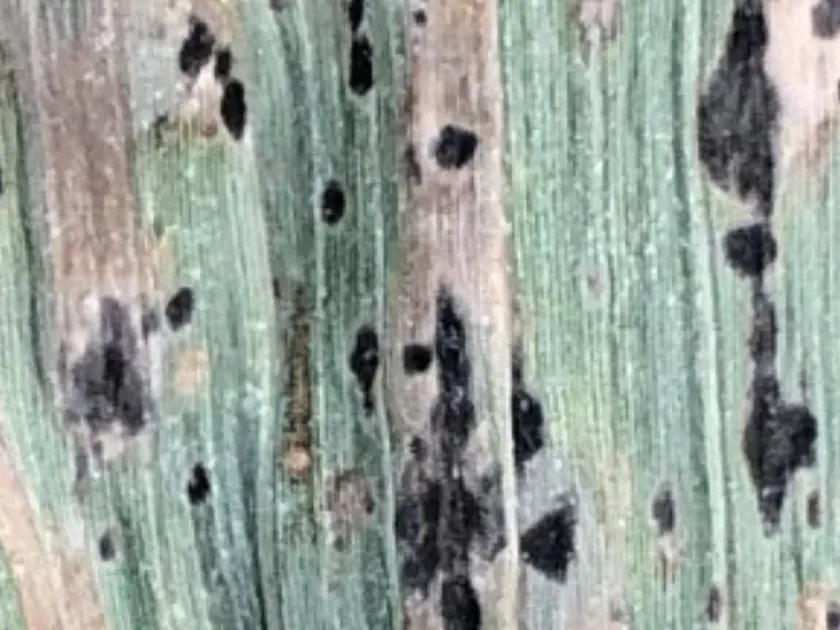
The hallmark symptom of tar spot is the appearance of small, raised, black specks on the leaf blades, which resemble spots of tar, hence the name of the disease.
Initially, the lesions appear as small chlorotic or necrotic spots, which eventually develop into the characteristic raised black stromata that are firmly attached to the leaf epidermis.
In severe cases, the lesions become so numerous that they coalesce, leading to extensive tissue death and premature drying of the leaves throughout the canopy.
The infection typically starts on the lower leaves and progresses upward, eventually covering the entire plant, including the husks of the ears.
Unlike other fungal leaf spots, the black specks are usually non-rub-offable and feel slightly gritty to the touch, distinguishing them from other debris or pathogens.
Pathogen
The causal agent of tar spot of corn is the obligate biotrophic fungus Phyllachora maydis, which belongs to the class of Ascomycetes. This pathogen depends entirely on living plant tissues for its development and survival.
The life cycle involves the production of small, black, raised structures known as stromata on the leaf surface, which contain the spores (ascospores) of the fungus.
These spores are primarily disseminated by wind and splashing rain, allowing the infection to move across fields and between neighboring plants effectively.
The fungus overwinters on infected crop residue. When spring conditions become favorable, these residues release spores that serve as the primary inoculum for the next crop.
The pathogen is specialized in its host range, primarily affecting maize, and its biological activity is heavily dictated by the presence of prolonged moisture.
Conditions for development
Tar spot development is strongly favored by cool to moderate temperatures combined with high humidity and leaf wetness duration, such as prolonged cloudy weather or frequent rainfall.
Nighttime temperatures remaining moderate, paired with consistent morning dew, provide the ideal environment for spore germination and colonization of the host tissue.
High planting densities can exacerbate the disease by creating a humid microclimate within the crop canopy, facilitating the movement of spores between leaves.
Lack of crop rotation and the presence of abundant maize residues from the previous year significantly contribute to the rapid buildup of the inoculum in the field.
Geographic regions that experience persistent moisture during the mid-to-late vegetative stages are most susceptible to significant outbreaks of tar spot.
Why it matters
The primary damage caused by tar spot is the reduction of functional leaf area, which significantly restricts the plant's ability to perform photosynthesis.
As a result, grain filling is impaired, leading to lower test weights, poorly developed kernels, and overall lower grain yield at the end of the season.
Infected plants are also prone to stalk rot and lodging because the disease accelerates the senescence process, weakening the structural integrity of the corn stalk.
Severe infections can lead to significant yield losses, potentially reaching 20-30% or more depending on the timing of the infection and the susceptibility of the hybrid used.
The loss of yield is compounded by the decreased quality of the harvested grain, which may not meet commercial standards for weight and nutritional content.
Protection
The most effective strategy for managing tar spot is the use of resistant or tolerant corn hybrids, which offer the best defense against Phyllachora maydis.
Cultural practices, such as tillage to bury infected crop residues, can help accelerate the decomposition of the fungus and reduce the level of primary inoculum.
Rotating corn with non-host crops is a crucial strategy to break the life cycle of the pathogen and prevent the accumulation of spores in the field environment.
Fungicide applications can be effective if timed correctly, specifically targeting the period before or during the onset of the infection to limit its spread.
Scouting fields regularly is essential for early detection, allowing farmers to make informed decisions regarding the timing of fungicide interventions to protect yield.
Discussion
No discussions yet — be the first.