
Taphrina
Taphrina
The causative agents of the disease are fungi from the genus Taphrina, belonging to the Ascomycota division. These are highly specialized parasites that primarily infect plants of the Rosaceae family.
What the section contains
Taphrina
The fungus develops within the host plant tissues, entering through young bud scales or micro-cracks in the bark. The pathogen's mycelium is perennial and capable of overwintering inside infected shoots.
During its life cycle, the fungus forms asci with ascospores directly beneath the leaf cuticle. Upon spore maturation, the cuticle ruptures, which visually manifests as a specific bloom on the leaf surface.
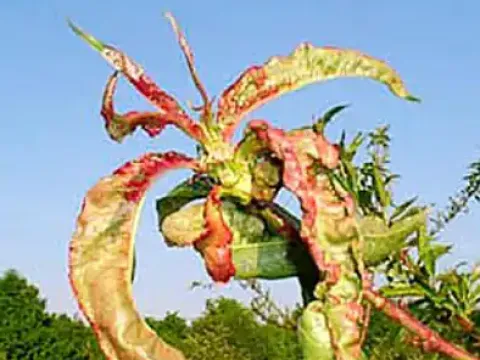
The most well-known species is Taphrina deformans, which causes peach leaf curl. Other species affect plums, cherries, and sour cherries, causing condition known as "plum pockets" or fruit bladders.
The infection persists in buds and bark, becoming active in early spring when buds begin to swell. Re-infection occurs through the release of spores spread by wind and rain droplets.
The first and most noticeable sign of infection is anomalous leaf deformation. Young leaves become crinkled, curled, and change their color to reddish-brown.
Over time, a grayish, powdery bloom appears on the lower, and sometimes upper, side of the deformed leaves. This is the sporulation layer of the fungus, which serves as a source for further spread.
In stone fruit infections, such as in plums, the formation of "pockets" occurs. The fruits become deformed, expand, fail to form a pit, and the pulp quickly starts to rot.
Severely infected leaves gradually dry out and drop en masse by early summer. This leads to premature defoliation, which significantly weakens the tree before winter.
Shoots of infected trees may show atypical branching and twisting, often called "witches' brooms." Infected shoots become more brittle and thickened compared to healthy branches.
The development of the infection is favored by prolonged cool and wet weather during the spring. The optimal temperature range for infection is between +10°C and +18°C.
The bud-burst period is a critical phase for disease development. If frequent rains and high humidity occur at this time, the risk of mass fungal spread increases significantly.
A dense tree canopy that prevents proper air circulation creates an ideal microclimate for spore germination. Moisture stagnation on leaves accelerates mycelium development within plant tissues.
Poor orchard management, which weakens the plant's immune system, also promotes infection. Trees growing in low-lying areas with poor drainage are more susceptible to the disease than others.
Once stable dry and hot weather is established, the development of the disease usually slows down. However, spores remain viable until the next season, settling in bark crevices and bud scales.
The main danger of Taphrina is the sharp reduction in the tree's photosynthetic activity. The loss of a significant portion of the foliage leads to a disruption of carbohydrate metabolism.
The disease negatively impacts the formation of flower buds for the following year's crop. Due to the depletion of nutrient reserves, the tree may skip a fruiting season entirely.
Infection of fruits renders them unsuitable for consumption or processing. Mass infection can lead to the loss of up to 80-90% of the potential crop in unfavorable years.
Severely weakened trees become vulnerable to secondary infections, pest infestations, and winter frost. Repeated disease cycles often lead to the death of the orchard within a few years.
- Reduced cold hardiness of the plant.
- Premature fruit drop.
- Wood exhaustion due to leaf loss.
- Poor fruit quality when affected by "pockets".
The primary control method is preventive treatment with copper-based fungicides before the start of the growing season. The first spray is applied in early spring at the "green tip" stage.
It is crucial to perform sanitary pruning of infected branches immediately after signs of the disease are discovered. Removed parts must be burned, as they act as a source of spores.
Improving orchard practices, including proper pruning and canopy thinning, facilitates ventilation. This reduces humidity within the canopy and prevents fungal mycelium growth.
During the growing season, if initial signs are observed, systemic fungicides may be applied. It is important to rotate products to prevent the development of resistant pathogen strains.
Balanced nutrition, particularly with potassium and phosphorus fertilizers, enhances the tree's natural resistance. A robust, healthy tree handles infection pressure much better.