
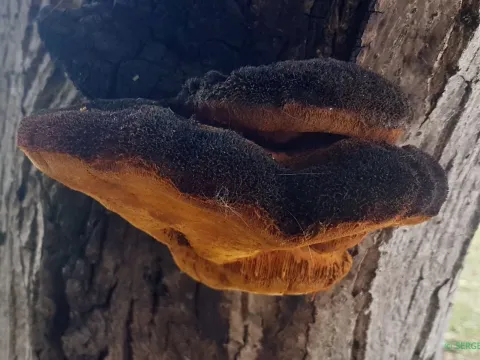
Shaggy bracket
Inonotus hispidus
The causal agent of this disease is the wood-decay fungus Inonotus hispidus, a member of the Basidiomycota division. It is a parasitic fungus that targets living hardwood trees, entering through wounds, pruning cuts, or frost cracks in the bark.
What the section contains
Shaggy bracket
The fungus develops silently inside the trunk for several years before producing visible fruiting bodies. It triggers an aggressive form of white rot, which gradually degrades the structural integrity of the wood, particularly the heartwood.
Its life cycle relies on basidiospores that are dispersed by wind and rain. Upon landing on a vulnerable area of a tree, these spores germinate into mycelium, which begins to colonize the tree's internal vascular and structural tissues.
Fruiting bodies of the fungus are annual and typically appear from mid-summer to autumn. They are spongy, cushion-shaped, and covered in stiff hairs, which gives them their characteristic appearance and common name.
The pathogen is highly adapted to weakening the host's defenses. It thrives by slowly depleting the tree's nutrient reserves while simultaneously destroying the structural support tissues of the trunk or main branches.
The most prominent sign of infection is the appearance of soft, yellow-brown to dark rusty-brown fruiting bodies directly on the bark. They are often found near branch unions or previous damage sites.
Leaves on infected branches often show signs of early yellowing, wilting, or premature shedding. The canopy becomes sparse, and the overall growth rate of the tree significantly declines over a single growing season.
Internal examination of the wood reveals extensive white decay, often marked by dark, irregular zone lines. This decay makes the wood brittle, leading to a loss of strength that can cause major limb failure during windstorms.
The bark overlying the infected area may become sunken, cracked, or show signs of dead tissue. Under the bark, a dense mat of white mycelium can often be observed, actively decomposing the cambium and underlying sapwood.
In advanced cases, the trunk may appear healthy from the outside, but the core is effectively hollowed out by the fungus. This poses a significant structural risk, as the tree may collapse without prior warning.
The development of Inonotus hispidus is heavily dependent on high moisture levels. Rainy seasons provide the necessary environment for spores to germinate and for the mycelium to spread rapidly within the wood.
Mechanical damage is the primary gateway for the fungus. Poorly executed pruning cuts that remain unsealed create perfect entry points for spores to establish an infection in the heartwood.
Trees that are stressed due to drought, poor soil conditions, or pest infestation are significantly more susceptible. Their weakened immune systems cannot effectively compartmentalize the fungal infection.
Warm temperatures, ranging between 15°C and 25°C, are ideal for the rapid growth of the mycelial network inside the trunk. During these conditions, the fungus aggressively breaks down the lignin and cellulose of the host.
The presence of nearby decaying wood or older, already infected trees serves as a persistent reservoir for new infections. Neglecting orchard hygiene allows the fungal spores to continue circulating in the immediate environment.
The Shaggy bracket is considered a serious threat to both orchard trees and landscape specimens. It causes irreversible damage that eventually leads to the death of the host tree.
The primary economic harm is the loss of fruit production and the eventual destruction of the tree itself. Once the wood is significantly decayed, the tree's productivity drops to near zero.
Beyond plant health, the fungus represents a severe safety hazard. Large, infected branches or entire trees can break suddenly, posing a risk of damage to property and injury to people nearby.
Management of the fungus is notoriously difficult. Because the mycelium grows deep within the trunk, standard topical treatments are ineffective at curing the disease once it has established a strong foothold.
The spread of spores leads to a decline in the entire local tree population. If not managed properly, one infected tree can lead to the widespread contamination of an entire garden or plantation.
Strict sanitary practices are the foundation of effective control. All visible fruiting bodies must be removed and destroyed by burning to prevent the release of more spores into the environment.
Pruning tools must be sterilized regularly to avoid cross-contamination. Any pruning cuts must be sealed with appropriate wound dressings to prevent the entry of fungal spores into the fresh sapwood.
Maintaining tree vigor is the best natural defense. Regular fertilization, proper irrigation, and attentive care help trees maintain the energy reserves needed to resist and compartmentalize fungal infections.
Preventative application of copper-based fungicides can help protect the bark surface from initial spore colonization, particularly after periods of storm damage that may have exposed the internal wood.
When the infection is advanced, removal of the entire tree is the only recommended solution to ensure safety and prevent further spread. The stump should be removed or treated to eliminate the reservoir of the infection.